All of my long-time readers know that I only fully endorse training products that I completely believe in. In an industry where shady marketing and scam products run rampant, it’s of paramount importance that people get clear direction regarding what fitness equipment to invest in. You can count on me to call it like I see it.
Allow me to introduce you to what may change the face of the entire fitness industry. This product has been featured on highly-esteemed and prestigious television shows such as: The Ellen Show, Jimmy Kimmel Live, Saturday Night Live, The Jay Leno Show, and South Park. It’s been used by the New York Jets, Queen Latifah, Jennifer Love Hewitt, Jennifer Aniston, Emma Stone, Chuck Liddell (pro MMA fighter), and Charles Barkley (pro basketball player) among others.
Only a product that guarantee’s “firm and fabulous arms and shoulders” in just six minutes a day could receive so much attention. That’s right folks! Introducing the one – the only – Shake Weight fitness training equipment…gadget…tool…thingy.
Dwayne Johnson, sometimes known as “THE ROCK” in certain underground sub-cultures has been quoted ON RECORD saying “there’s something inappropriately interesting about the motion… And it’s by your face.”
With such a precise analysis and the resulting spike in sales from celebrity exposure, there’s no question in my mind that someone needed to review this product.
Everything you ever wanted to know about clubbells – the world’s best club swinging tool for strength training.
The clubbell is a club swinging tool that is primarily used for strength and conditioning, fitness training, and athletic performance enhancement. I’ve been using clubbells regularly since 2006, and it’s about time that I give this great piece of equipment the attention it deserves. I’ve seen what they’re capable of, and to tell you the truth, I’m very impressed.
Given that clubbells are not cheap, you should probably know the whole story before making your first purchase. I know what it’s like being a first-time buyer – you’re skeptical. I was too. Back when I first learned of clubbells, I was a fresh out-of-college, soon-to-be married personal trainer with very little disposable income. Every penny counted, and I wasn’t about to blow a bunch of money on a scam product that would collect dust in my home gym. I needed to know if it would be worth the investment BEFORE I spent my hard-earned cash.
The RMAX organization makes some bold claims concerning the clubbell. Truth be told, I think some of them are way over the top, but that doesn’t mean I would discourage anyone from looking into purchasing a clubbell. It’s just important to educate yourself and understand the TRUE advantages, disadvantages, and proper applications before you pull out that credit card.
This review is meant to help you in two ways: 1) learn all about the clubbell training tool itself, and, 2) decide if it’s right for your situation. I’d also like to offer you a free gift if you do decide to invest in the clubbell.
Clubbell Review Components:
1) Learn all about the Clubbell equipment itself in the Product Review (videos): This is where you’ll get all of your product-related questions answered, including detailed information about what the clubbell is, what it’s made of, quality and design considerations, what makes it unique, and who the clubbell is best suited for (and not best suited for).
2) Determine if the Clubbell is the right training tool for you: This section will deal specifically with who can benefit from the clubbell, and who cannot. If you’re trying to make up your mind about whether the clubbell is right for YOU and your circumstances, then this section will provide you with the answers you need.
You’re about to get an inside look at what clubbells are REALLY all about. This is a long product review, as I wanted to err on the thorough side and try to cover everything. So, let’s take a detailed look at the clubbell, the world’s best club swinging tool.
The pushup is one of the oldest recorded strength training exercises. Martial artists, yogis, and athletes have been cranking out reps of pushups for thousands of years. Without a doubt, the pushup has stood the test of time and is an invaluable addition to many strength training programs. But is the pushup all there is? Could there be, dare I say, something better? Some people would have you believe there is, and we’re about to explore that notion while we take a close look at the pushup board training tool.
The pushup board has been touted as an “ancient tool for the modern warrior,” receiving praise from many strength coaches including Steve Maxwell, a world champion in Brazilian Jiu-Jitsu. I met Steve back in 2006, and was quite impressed with his movement skills and coaching abilities. So, when Steve puts his seal of approval on a training tool, I pay attention. I’m also one to rigorously evaluate everything I endorse, and if a tool just doesn’t cut it, you’re going to know where I stand on the issue (even if well-respected coaches like Steve disagree with me). The pushup board has distinct practical purposes, but it also has a number of drawbacks, which I cover in-depth in this video review.
The Pushup Board – Review of the Pros, Cons, and Alternatives
I just read a news story about a guy who won a 10k race wearing nothing but a pair of Barefoot Ted’s Luna Sandals. This got me thinking about the hype surrounding barefoot running and minimalist footwear. At first glance, it could appear that avid barefoot and minimalist runners would have you believe that running barefoot (or going “light”) is the secret to better race times, injury-free running, and eternal youth. At times, it feels like this is an overarching theme in the barefoot running community – that all you need to do is stop wearing shoes and everything else will be taken care of. It’s as if the decision to go barefoot is the Holy Grail of running – curing every ailment, boosting all aspects of performance, and making the whole world a better place. Quite the romantic idea!
Well, I hate to burst your blister, but it doesn’t work that way. Running barefoot (or minimalist) is only a tiny fraction of the total running experience, and only a small contributor to successful running. Sometimes, going barefoot even does more harm than good. The most important thing is that people are informed of all their options and the possible resulting consequences of each decision they make.
The Four Pillars of Successful Running:
There’s a lot that goes into successful running. Of course, the phrase “successful running” is subjective and interpreted differently by many people. Some runners are successful when they win a race, and others are successful if the decide to get off their butts and go for a jog some Sunday afternoon. Every person defines successful running differently, but there are a few constants that I think apply to everyone.
1) Being able to run efficiently and therefore avoid experiencing pain or injury. Injuries from running obviously indicate unsuccessful running, no matter who you are or why you run. If you’re an injured runner, you’re an unsuccessful runner. What you’ve been doing isn’t working for you, and it’s time to re-evaluate. This also means that the majority of runners are unsuccessful (I’ve been there!). 2) Not only being able to avoid pain and injury, but also using running as a health and fitness improving activity. Running shouldn’t hurt us. It should make us healthier, fitter, and stronger – both physically and mentally. 3) Being able to run effectively, and therefore be able to achieve personal performance goals each and every run – even if that goal doesn’t involve breaking a new personal record.
Those are the logical pillars, but I’d like to add one more that doesn’t technically qualify, but I still think is absolutely important.
4) Not only receiving personal satisfaction after you’ve completed each run, but also enjoying each run in the present. If you have achieved the above 3 pillars, but still don’t enjoy running, then you’re not a truly successful runner in my book – at least not in the spirit of Physical Living.
Those four pillars can serve as a bare minimum of what must be involved in order for a run to be considered successful. There are certainly other variables that can apply, but these are the very basics. The rest are just details. Of course, some people would have you believe otherwise…
Adjustable kettlebells seem like a clever idea, but I doubt that anyone on earth would actually enjoy using such an awful invention after my experience with them. Kettlebell handles certainly fill a niche need, but there are definitely some disadvantages that should not go overlooked.
Several years ago, a friend of mine gave me one of his Kettlestack adjustable kettlebell handles. He had just invested in some standard kettlebells of his own, and was happy to get rid of that old, clanky kettlebell handle. It was his loss and my gain, or something like that, and I appreciated the gift. Although, over the next few months, I learned exactly why he was so eager to get rid of it.
In a word, adjustable kettlebells are simply awkward. In two words, they’re awkward and cheap – not to mention flimsy, inefficient, uncomfortable and even dangerous to an extent. For the most part, I don’t recommend adjustable kettlebells or any type of kettlebell handle at all, and I hope you never have to use one for weeks or months like I did. That said, it’s important to be fair and offer both the advantages and disadvantages of each training tool. So, I put together this product review to explain exactly why I don’t like adjustable kettlebells, and why you probably wouldn’t either. If you’ve been thinking about getting an adjustable kettlebell, you might think twice after you see this review.
Adjustable Kettlebells VS Standard Kettlebells – Video Review
*Please note: the adjustable kettlebell featured in the above video is not actually an authentic Kettlestack – it is a replicated version.
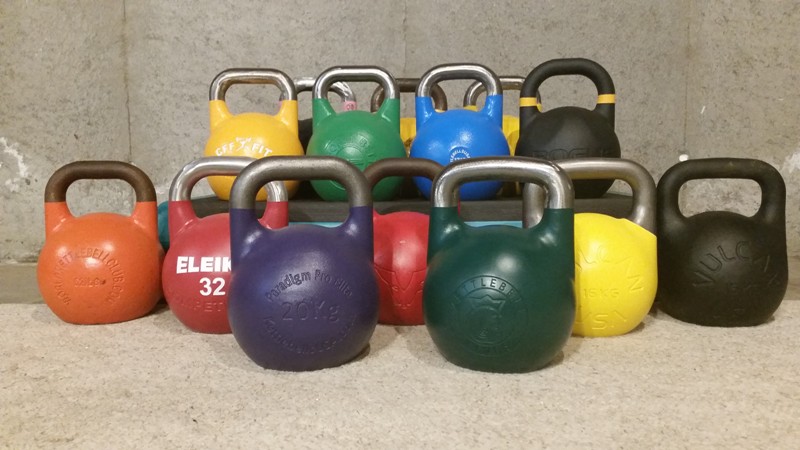
Even though, both standard grade (iron) kettlebells and pro-grade (steel) kettlebells are lightyears ahead of any type of adjustable kettlebell, I only fully endorse and recommend professional-grade kettlebells. If you’d like to know why these are the best type of kettlebell, then please read my First Time Kettlebell Buyer’s Guide below. Continue reading Adjustable Kettlebells VS Standard Kettlebells
You’d be crazy to buy Russian kettlebells after you’ve seen how much the prices are marked up. See up-to-date prices from several of the leading kettlebell manufacturers below.
Russian Kettlebells
So, I was in the market for some new kettlebells and I decided to do some market research to find the best deals online. What I found was part liberating and part infuriating. After a little bit of shopping around, numbers crunching, and adding all the data to a spreadsheet, the results were downright shocking. I quickly discovered that one of the leading retailers for Russian kettlebells have their products consistently marked up over 200% from its competitors. Now, I can understand a marginal markup, but when you have the ability to offer your products at 50% off and STILL be more expensive than the competitors, something is wrong. Even shipping is more expensive than some of the competition.
One leading retailer for Russian kettlebells (I won’t mention names… yet) sells a 16kg Kettlebell for $125.95. That price is for a single kettlebell shipped anywhere in the lower 48 states of the continental USA. Another leading retailer for Russian kettlebells charges $54.95 for the same type of kettlebell – and that also includes shipping.
Today, a competition was held worldwide in International Clubbell Sport. The club swinging greats from all around the globe joined together for some massive sweating, callouses, blisters, and fun.
This is my first official clubbell competition, and I competed in the 15 lbs division. Here are my results…
Total Double Clubbell Swipes completed in 10 minutes: 160
Total Single Clubbell Mills completed in 10 minutes: 128 (129R, 128L)