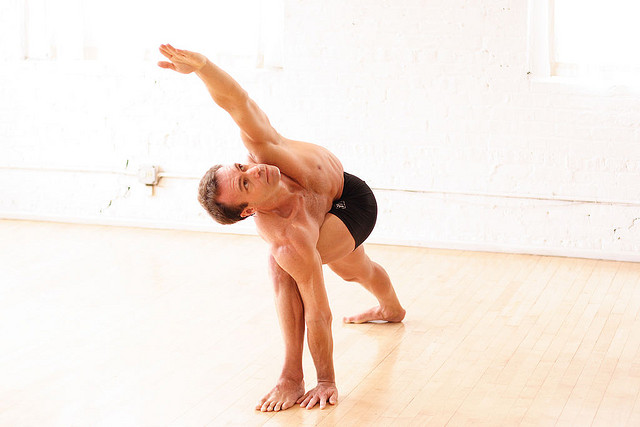
The Elbow Plank VS Pushup-Position Plank

QUESTION: John, what is your recommendation and/or can you explain the different benefits of the high plank vs. the plank while on elbows?

The Elbow Plank VS Top-of-Pushup-Position Plank

ANSWER: The high plank, also known as the “top-of-pushup position,” is identical to the typical elbow plank, except for the fact that your arms are extended and fully locked out. This accomplishes two things:
Continue reading The Elbow Plank VS Pushup-Position Plank

TACFIT Warrior FAQ for Consumers

QUESTION AND ANSWER:

Hi John,

I have been following TACFIT Commando, from the fence, for some time and have tried some of the exercises. They seem like a good fit for me and are quite challenging, and I think I am ready to purchase one program or the other (e.g TF Commando or the newer TF Warrior). I wondered if you would please comment on any differences. I am interested in some aspects of both programs. How are they different? My interest is for general fitness and martial arts. Appreciate whatever comments you can offer, and thanks for such extensive reviews.

Happy Holidays,

Mike

TACFIT Warrior VS TACFIT Commando

TACFIT Warrior

TACFIT Commando

Hey Mike,

This is a great question and you’re not the first to ask, so I’m posting my response here. First things first… Here is the official answer from Scott Sonnon himself:

Question: What is the difference between TACFIT Commando and TACFIT Warrior?

Answer: “Commando and Warrior are parallel in intent for physique and performance goals: the fat melting, muscle chiseling virtues are equal. Warrior adds a mental component not present in Commando, and as a result includes unique “cross-brain” exercises to train hard AND smart.”

That’s an accurate summary, but it’s also pretty vague. Let’s dive into the nitty-gritty details. First, the similarities…

Continue reading TACFIT Warrior FAQ for Consumers

Q+A: Can You Get Injured From Gentle Exercise?

Intu-Flow

QUESTION:

Hey John, I’ve never contacted you before but your website has been instrumental in shifting my training focus from Dragon Door and Kettlebells towards Circular Strength Training with a long-term view to MovNat or Parkour-style movement skills.

Grandiose plans to be sure! A journey with a thousand steps and all that, I decided to concentrate on Intuflow and for the last 3 weeks have been doing the beginner level daily. My problem is that I’ve started picking up some injuries even from that! Lower back and shoulder. Some parts of me, like my wrists and knees, feel great from the practice. Is it normal for some folks to pick up niggles even from simple mobility drills?

It seems that no matter what I do lately it, aggravates some part of me. I shall be going through the video again but I’d appreciate your thoughts given that I know you went through a steep learning curve with mobility stuff yourself.

Thanks, Colin

ANSWER:

First off, I can definitely relate. I’ve been there, and I’ve been frustrated just like you. You’re only in three weeks (which is great!), and that’s enough time to learn quite a bit about your mobility. You’re facing resistance to the changes you’ve made in your training program, and you’re asking for help, which means that you’re committed to seeing this through to success. Keep it up, Colin!

Now, that is a GREAT question because you bring up a very important point concerning the nature of Intu-Flow joint mobility training (or any prehabilitative training, for that matter). Nobody starts a new training program with a blank slate. We all carry a lifetime of tensions, hidden or known pains, weaknesses, stored deficits, and general limitations throughout our bodies. These are issues that are present in the body before you even started your Intu-Flow training, and for most people, this is exactly why they start an Intu-Flow practice in the first place. Prehabilitative training is, in part, a process of cleaning the slate to remove these impediments. In doing so, you directly confront your restrictions on a daily basis, seeking to slowly unwind them through gradual tension release and the recovery of basic ranges of motion.
Continue reading Q+A: Can You Get Injured From Gentle Exercise?

TACFIT Commando FAQ and Concerns From a Hesitant Buyer (Q+A)

Note: I received some questions from a hesitant buyer about TACFIT Commando this morning. They graciously allowed me to republish my response here on my blog. Their name has been left out for anonymity sake.

QUESTION:

Hello John,

Thanks again for your responses to all my questions! I wonder if I could ask you a few more questions, this time about Tacfit Commando. One of the things that has impressed me so much about CST is its extensive vocabulary of bodyweight exercises. While many of these movements are not absolutely unique to CST, they are thoughtfully put together all in one place, with accompanying forms of joint mobility, compensation, etc. One of the challenges of being a newcomer to CST is sorting through all the different products, and trying to differentiate them from each other and determine their distinctive value. I am delving into Flowfit and Intuflow. I think I can already appreciate (and more importantly feel) their commonalities and differences. To me, being able to move in a sophisticated manner is much more compelling than increasing my bench press!

Tacfit Commando looks like a very interesting product. I tried the Israeli Challenge and truly enjoyed it, even if movements like the quad squat, springing tripods, and swinging planks were not entirely new to me (for example, they are all in Flowfit). The marketing of Commando, however, has me very wary. Frankly, I think it is packaged in a hokey manner that makes me feel like I’m being sold snake oil. This comment has nothing to do with the goal of training soldiers, the sincerity of Commando’s creators, etc. It is simply a comment on how
it is all packaged. I feel as though the approach can stand on its own without all that artifice (i.e. Intuflow has little artifice and amazing content), and the artifice makes me wonder about the value of its actual content!

I know you do not endorse products lightly. In fact, your endorsement is encouraging me to give Commando a chance. As there are pros and cons to any approach, I wonder if you could suggest some of the weaknesses in Commando. What kinds of athletic goals and plans would it not be particularly well suited for? Could you give me a sense of how it differs from products like BER? Can it be incorporated with other forms of resistance or endurance training? Is there a substantially new vocabulary of movement in Commando as opposed to
what has come before?

I’m not expecting you to say anything negative about your colleagues, or put you in a bind, but I thought it might be helpful to get feedback from one person who thinks the packaging is a real turn off (i.e. Sonnon’s statement that the enemy is not honorable enough to do the workout- I mean c’mon…). I will probably end up purchasing Commando before the initial deal expires, but hoped your feedback could help me make an informed decision.

Many Thanks,
Anonymous

ANSWER:

You’re very welcome. I’d be happy to assist you in your buying decision. Times are rough and money is tight, so I want to make sure you don’t feel like you’re getting scammed into something that isn’t right for you.

I hear you on the marketing, but as I said in my email newsletter… If you take away all the marketing, all the shiny signs and fancy sales copy, and leave ONLY the program, I think it stands alone as an excellent product, which is why I gave it an endorsement. If I were in charge of releasing it, I’m sure I probably would have done it a little differently, but let’s get to your questions.
Continue reading TACFIT Commando FAQ and Concerns From a Hesitant Buyer (Q+A)

How to Setup a DIY Fitness Plan For a Broad Range of Goals - Training Q+A

QUESTION:

Hello John, Thank you for your site. It is a tremendous resource. After years of running and swimming regularly (a few pull ups and push ups mixed in) but without any sort of training strategy, I’ve become more deliberate about my “physical living” over the past several months. Bodyweight training has figured prominently in this shift, as it aligns with my lifestyle and physical goals. Gyms don’t let you bring the dog along, or provide sunshine! I’ve collected a few tools along the way to add variety- a rope for climbing, homemade parallettes and adjustable straps, a timer for HIIT sprints, a sledge hammer, jump rope, sand bag, pull up bar, and balance ball. I’m learning more about the work of individuals such as Steve Maxwell and Scott Sonnon. Also, I’ve just started Intuflow.

I appreciate your emphasis on tailoring workouts to individuals. My training goals are oriented towards long term physical health. Though the idea of sophisticating movements is very appealing to me, I seek general preparedness for activities like hiking and surfing. Given these generalist tendencies, and my desire for variety and the ability to alter workouts due to weather conditions, daily schedule etc., I don’t think programs like the 4×7, prescribed workouts of the day, or alternating complementary cycles are for me. At the same time, I don’t want variety to descend into randomness.

It is difficult for a novice to wade through the sometimes heated disagreements between proponents of different training strategies. For elite athletes, the consequences of poor training can be serious and severe, but it is hard to know how and whether these arguments truly apply to someone with my goals. Since I am coaching myself, I lean towards safety, and do not push my limits in the way that an elite athlete might. I am willing to work hard, hoping to work smart, and interested in sophisticating my skills. Many programs intensely focused on maximizing particular results, however, don’t fit me too well.

I wonder whether you might provide some general training guidelines for someone in my situation. I don’t want random variety without any direction or deliberation, but I like the ability to just go on a nice run in the woods when it fits the weather or my mental state. I realize my question may eventually lead to a more intense engagement with the CST system (ideas of compensation and functional opposites), but in the meantime, are there some guidelines I can follow to fit balance variation with the desire to train safely and progress over time?

Thank you for your time.

Sincerely,
James

Continue reading How to Setup a DIY Fitness Plan For a Broad Range of Goals – Training Q+A

The holy grail of fitness goals: Look good and BE good! -- Reader Q+A

QUESTION:

Hi John, I’m 43 y.o male , 1.85 m , 80kg , i discovered Tom Venuto’s BFFM ebook last February and by applying his program got rid 10 kg of fat and now I am at about 12.5% BF and in the better shape of my life from a BF point of view . I want to drop some more fat  (to less than 10% BF) and put some serious muscle on as next goals. What I realized reading your blog (but this is something i always felt intuitively) is that I miss the mobility part in my fitness, I’m much less mobile and efficient from a functional stand point that i would like and this limits my potential obviously. I liked very much your holistic philosophy to fitness and watching your videos it’s clear you have much wider freedom of body movement than most of the gym attendants or bodybuilders. I’d like a muscular body but not a stiff , just bulky one as those i see too often in the gym , I want to be ripped , muscular AND flexible/coordinated/functional. So I would like to ask you, what  do you advise me to add to my training routine (which is weight training + cardio  5 days per week )?

Best regards,
Massimo

Continue reading The holy grail of fitness goals: Look good and BE good! — Reader Q+A

How to Run Better for the Perfect Run: 5 Things That I Do Differently Now That I Know Better

run happy

Running should be a joyful experience, not a boring or exhausting workout.

Today, I went for the perfect run. Why was it perfect? Because I utterly enjoyed it, and I know that it was exactly what I needed today. That’s how training should be – our desires should line up exactly with our needs.

Not only was I eager to get outdoors and run, I wanted to do it right. I wanted to practice the perfect run and know that when I was finished I had done something right and good for me. Allow me to elaborate.

I ran Fall cross country, Winter Track, and Spring Track and Field in high school, and my events were the long distance events. I put a LOT of miles on my body in three years. So many miles, in fact, that I overtrained into injuries that ultimately led to almost three years in physical therapy, which was terminated early because I had maxed out the funds my health insurance was covering. I won’t bore you with the details.

It’s probably too obvious to say that I approach long distance running with caution these days. In fact, I remember saying that I would never run again. That’s what the doctors and specialists were telling me, and I eventually believed them for awhile. I’ve learned a lot about running since then, including many things that I would do differently if given the chance to return to the past.

Today, I definitely will not allow myself to stumble back into the running methods of my youth. I approach each run in a very different manner than I used to, and I want to share some tips about how to run better with you.
Continue reading How to Run Better for the Perfect Run: 5 Things That I Do Differently Now That I Know Better

Page 1 of 41234