
A Complete Pullups Workout Program to Help You Shatter Your Personal Record and Dramatically Improve Your Pullups Performance
Note: this pull-up training program is one of the lessons in my free 5-day Pull-up Training Crash Course. If you haven’t signed up and you want to improve your pull-up strength and performance as soon as this week, then Click Here to learn more about the free course. I’ll hook you up with the rest of the lessons and my very best tips on mastering the pull-up and chin-up exercises.
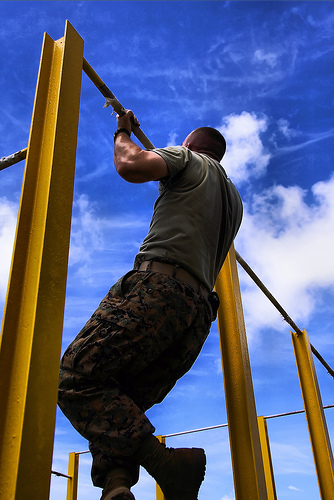
If you want to strengthen your arm and back muscles, spread your wings (lats) to create that V-tapered back appearance, and increase that critical vertical pulling strength that everyone needs, AND if you want a laser-focused pullups program that was created exactly for improving your pullup numbers, then you’ve come to the right place. Below, you’ll find a complete workout program with several pullup workouts that you can use to accomplish these goals.
How I Went From 6 Deadhang Pullups to Over 30 in Only 3 Months
Back when I was in high school, I followed a 52-week workout program right out of the book Maximum Fitness: The Complete Guide to Navy SEAL Cross Training
Now, 30 pullups might not seem all that impressive with some fitness trainees regularly nailing sets of 50 or even 100 kipping pullups in a row. But here’s the thing. These were deadhang pullups, and being able to perform 30 deadhang pullups is almost unheard of – even today. I studied up on basic pullup technique, and while I didn’t understand the nuances of this movement at the time, I did make sure to follow the basic recommendations outlined in most exercise textbooks.
I’m confident that anyone who is healthy and of normal weight could approximate my level of success, and today, I’m going to share my complete program for how to rapidly increase your pullup and chinup numbers.
The “Over 30 Pullups In 3 Months” Complete Workout Program
Sure, you could just follow the pullup workouts in the book I used, and that would probably work just fine, but not everyone wants to train like a Navy SEAL. So, I’ve outlined what I would recommend for a complete pullups program, and it’s actually very different than what you’ll find in the book.
But what if I can’t even do 5 pullups? Heck, what if I can’t even do ONE?
Whatever your level of conditioning or skill, you can start using this program to start building your pullup strength – whether you can already do 30 pullups or even if you can’t do a single pullup. The following program can be modeled using any of the following exercises:
Beginner level 1: flexed-arm hangs
Beginner level 2: negative repetition pullups
Beginner level 3: the many forms of assisted pullups (partner-assisted, band assisted, or jumping pullups, etc.).
Intermediate level 4: deadhang pullups (ie traditional pullups)
Advanced level 5: weighted pullups
Whichever level you’re able to do comfortably and with good technique, you should start the first month using that particular technique, and work your way up to the next levels, if possible.
Pullups Workout Program – Month 1: Grease the Groove Technique
For the entire first month, the most important thing you can do is practice pullup technique as frequently as possible. You can do this using the grease the groove technique, which is very simple. Several times each and every day (5-6 days per week, 1-2 days off), perform a sub-maximal set of pullups. Your goal should be to do as many pullups as possible throughout the course of each day. However you accomplish those reps is up to you, but here are some things to keep in mind to maximize your results.
Your goal should be to do more pullups than the day before – every single day you grease the groove. You’re slowly building volume over the course of the month. One other thing to keep in mind is that increasing intensity/effort is NOT the key this month. Fatigue is to be avoided, no matter how tempting it may be. Put your effort into your other training workouts. Hold back on the effort until month two. You’ll be glad you did.
The number of repetitions you do each set is dependent on two things:
1) your perceived level of maximum reps (% of max)
2) the amount of sets you’re planning on doing throughout the day.
If you only do a handful of sets throughout the day, then your repetition amounts should be higher (but never higher than 60% of your max reps per set). On the other hand, if you do a ton of sets throughout each day (ie 10-20+), then stay down in the 20-40% of maximum effort range – even as low as 1-3 reps per set is fine. So, the more sets you do throughout the day, the lower the repetition amount should be each set.
Keeping your technique solid is of paramount importance and will directly transfer over into better performance once we get into months two and three. Follow the instructions in my video about how to do pullups with perfect technique and start doing them in this way from day one. Of course, on your actual first day – perform your first set as a test to find out what your max is.
Get out a sheet of paper and post it somewhere you’ll see it regularly (or keep it in your wallet/purse), and use that to record the actual number of pullups you’ve done each day. Then break that record the next day.
Most people will notice a huge increase in their pullup numbers just after month one (often over double what you started at), which usually astonishes them because although it required frequent practice, it did NOT require much effort. You can chalk it up to practicing the technique and training the nervous system to perform it efficiently. If you’ve done this right, you’ll be primed for compressing your training into actual sessions and building volume next month.
Pullups Workout Program – Month 2: Building Volume With Pyramid Training and High-Volume Sessions
Grease the groove is all over now. No more practice sets throughout the day, no matter how tempting it is (though, you could start greasing the groove with another movement skill on the side). Be glad about the progress you’ve made, but it’s time to move on before you hit a plateau. This month your goal is to build volume during actual training sessions, and we’re going to do this with two different types of workouts that you’re going to alternate throughout each week.
If you can find a way to integrate these into your current training sessions, then by all means, do so. If it just won’t work, then either do these at the end of your workouts as “finishers,” or perform them at a different time entirely.
Pullup Workout A1: Double-Step Pyramid Training
Instructions: Perform a pyramid of pullups all the way up to your max and then back down again using multiples of two’s to climb each step. In this A1 session, you’re going to go up by doubles.
Here is an example of the progression: 2, 4, 6, 8, 10 (max), 8, 6, 4, 2 = 50 total pullups
Go up as high as you can while maintaining proper technique, and rest as much as necessary between sets. Instead of following a rigid structure for rest, just rest as much as you feel is necessary to complete the next step. Generally, I recommend using as little as 15 seconds of rest on lower levels, and up to 2 minutes on upper levels.
Pullup Workout A2: Single-Step Pyramid Training
Instructions: This is identical to the pyramid workout above, except this time (A2) you’re climbing the pyramid one repetition at a time.
Here is an example of the progression: 1, 2, 3, 4, 5 (max), 4, 3, 2, 1 = 25 total pullups
Here’s another example for performing 100 total pullups: 1, 2, 3, 4, 5, 6, 7, 8, 9, 10 (max), 9, 8, 7, 6, 5, 4, 3, 2, 1 = 100 total pullups
Go up as high as you can while maintaining proper technique, and rest as much as necessary between sets. Instead of following a rigid structure for rest, just rest as much as you feel is necessary to complete the next step. You’ll probably need a little more rest in between sets when climbing the pyramid via single steps.
Pullup Workout B1: Low-Rep, High Volume Training
Instructions: Select a number of repetitions based on approximately 20% of your maximum. So, if you can do 10-12 pullups in a maxed-out set, then your number is 2 or 3 repetitions. Perform 15-20 sets with as little rest as possible. Keep doing sets until your technique starts to decline, and stop if you reach 20 total. You’ll need to rest more during the latter sets, of course. Set a personal record each time you do this session by doing more total sets than your last session.
Pullup Workout B2: Moderate-Rep, High Volume Training
Instructions: Select a number of repetitions based on approximately 30-40%% of your maximum. So, if you can do 10-12 pullups in a maxed-out set, then your number is 3-5 repetitions per set. Perform 8-15 sets with as little rest as possible, and no more than 1 minute between rounds. Keep doing sets until your technique starts to decline, and stop if you reach 15 total. Set a personal record each time you do this session by doing more total sets than your last session.
Month 2 Training Schedule
Here is the training schedule to follow (it’s ok if you make some changes to this, just remember that less is more):
Week 1 – A1, B1 (e.g. A1 on Monday, B1 on Thur)
Week 2 – A2, B2 (e.g. A2 on Tue, B2 on Sat)
Week 3 – A1, B1, A2 (e.g. Mon, Wed, Fri)
Week 4 – B1, A2, B2 (e.g. Mon, Wed, Fri)
Note: these sessions can be done on any non-consecutive days, but ideally, they should be equally spaced apart throughout the week.
Pullups Workout Program – Month 3: Lowering Volume and Building Intensity to Peak for the Final Test
You’ve already laid a foundation of good technique in month one, perfected that technique and built a base of training volume in month two, and now is when the work starts to get hard because it’s time to increase the intensity of your sessions.
Pullup Workout C1: Descending Pyramid Session
Instructions: This is essentially half of a pyramid, and you are starting at the top and working your way down. Perform a near-max set of pullups (approximately 90% of your max reps), then rest for as long as necessary before performing a set of one less repetition, and continue this until you reach the final set of 1 pullup. Obviously, it’s very important that you’re adequately warmed up prior to starting this session (see joint mobility recommendations below).
Here is an example of the progression: 10, 9, 8, 7, 6, 5, 4, 3, 2, 1 reps = 55 total pullups
Pullup Workout C2: 50-100 Reps in as few Sets as Possible
Instructions: Perform between 50-100 pullups in as few sets as possible. Select the goal number based on your conditioning level. It’s probably best to try and select repetition amounts for each set that land around 60-80% of your maximum ability. So, if you can perform 10 pullups, then sets of 6-8 are probably optimal for this session. Rest as necessary.
Here’s an example for a goal of 100 repetitions:
10, 10, 10, 10, 9, 9, 8, 8, 7, 7, 6, 6.
Pullup Workout C3: Maximum Set Practice Sessions
Instructions: Repeat the following 3-5 times.
1 Set of of maximum pullups with 3-5 minutes of rest between sets
These are an all-out effort, and you should be trying to hit 100% exertion every time. Your repetition numbers will likely decrease every subsequent set. This is a sign that you’re doing it right. When you repeat this workout later in the month, try to score more total reps on your last set to both gauge and ensure progression.
Month 3 Training Schedule
Here is the training schedule to follow (it’s ok if you make some changes to this, just remember that less is more):
Week 1 – Rest. No pullup training at all. This is a time for your body to recover from the high volume training that you’ve done over the last two months and prime you for a few weeks of higher-intensity training. Other fitness training is ok, but depending on your program, it might be a good idea to take a 5-7 day break anyways (highly recommended if you haven’t taken a week off in the last 12 weeks).
Week 2 – C1, C2 (e.g. C1 on Mon, C2 on Thur)
Week 3 – C3, C1, (e.g. C3 on Mon, C1 on Thur)
Week 4 – C2, C3, C1 (e.g. Mon, Wed, Fri)
Week 5 – Pick a day for your pullup test. Plan ahead, and give it a shot.
Notes for maximizing your pullup test performance:
1) Get plenty of sleep at least a couple of nights before your test day.
2) Make sure you are fully hydrated well in advance. Start front-loading your water at least 48 hours in advance. The same should go for front-loading optimal nutrition as well.
3) Make sure you’ve taken at least 2 days off from ALL formal exercise, and 3-4 days would be better.
4) Perform a basic joint mobility session to prime your joints, muscles, and nervous system, increase your core temperature, and specifically prep the ranges of motion for the pullup exercise (prioritize the following: scapular shoulder circles, humeral shoulder circles and figure eights, elbow basic ranges and circles, wrist basic ranges and circles, hand and finger mobility – if you don’t know what these are, see here)
5) Perform a very low intensity warmup set – just a few reps to groove the technique without fatiguing you at all.
6) When you know you’re ready, step up to the bar, and know that you’ve spent the last 3 months preparing for this test and that you will ace it with flying colors.
The Bottom Line
If you follow the above program, then I guarantee that you will amaze yourself, as I did, with the results you can achieve in only three months time. There’s nothing quite like knowing that you’ve mastered a very challenging exercise, and on top of that, you’ll be turning heads in disbelief as you continue to rep out on the pullup bar. One last thing: the fitness benefits you experience will also be exceptional. You probably don’t care about that, though.
If you’re ready to get started, and haven’t done so already, check out my free 5-day Pull-up Training Crash Course, or see below for more info.
Click Here to Learn More About my FREE
5-Day Pull-up Training Crash Course
If you found this article helpful, please share it with your friends and tweeps:
.jpg "John Sifferman")

CST Coach, CST-KS
Health-First Fitness Coach
P.S. If you liked this post, then please signup for the newsletter, or follow me on Facebook or Twitter for daily updates and other interesting info.
Update: Want to Increase Your Pull-up Strength and Performance as Soon as This Week?
 Get John Sifferman’s Pull-up Training Crash Course and Download your FREE Special Report to Help you Instantly Increase your Pull-up and Chin-up Results
Signup for this FREE 5-day email course and you’ll get:
-A special report with 3 easy ways to help you instantly increase your pull-up and chin-up results (PDF format)
-A comprehensive pull-up technique guide to help you maximize your results and minimize the risk of injuries
-The top 3 things you can do to work up to and nail your first pull-up – even if you can barely hang from the bar
-3 advanced strategies to break a pull-up training plateau and score your first 10, 20, or even 30 reps
-7 tips for how to approach pull-up training when you’re injured
-And much more!
Just enter your email into the form below and I’ll send you everything for free. Stop struggling with pull-up and chin-up training and start getting results this week.

Hi John,
I’m a regular reader of Physical Living and just want to start by saying THANKS for providing all the great content. I especially enjoy the balanced view regarding fitness/wellness information.
Regarding this most recent post – I was wondering if the various percentages of ‘max reps’, especially in months 2 and 3, are percentages of the very first max test you perform on day 1? I suspect the maximum set of pull-ups I can do will increase over the course of the program; but for this program, I am understanding that all the percentages of maximum are based on the first test.
Many Thanks,
Roberto
Hi Roberto,
Thanks for the kind words, and good question.
Your max potential will definitely increase throughout the course of the program – maybe even doubling in the first month alone. So, in the program, when it says “% of max reps,” I’m referring to your percentage on that particular day, even in that particular moment. So, you will want to adjust the number based on how you progress throughout the program and also how you progress throughout each session (e.g. your max might decrease after several sets).
In the same vein, you might encounter a session where your max is lower than usual (maybe you’re not feeling well that day). For example, maybe you could do 10 reps last week, but today, you’d struggle to hit 7 or 8.
It is because of these cases that it needs to be based on your perceived level of exertion, which is a guess concerning how many reps you think you can accomplish if you tried to max out. We can guess these numbers based on both how we’re feeling that day, and also base it off of past performance.
It would be much easier to give explicit instructions like “do 10 sets of 5,” but that’s an arbitrary and impersonal standard that isn’t based on individual performance factors, which is why I like to use the perceived level of exertion (% of max) to help gauge your ability so that you can properly challenge yourself instead of try to conform to what is considered kosher.
I hope that makes sense, and if not, I’ll be happy to elaborate more. Good luck!
Hi John,
does it also apply to greasing the groove during the first month? I mean, if my 60% were around 4 or 5 pullups, would I then need to increase the overall number of repetitions by this margin every day? It may become quite challenging at the end of the month, as on the last couple of days you may find yourself in a situation, whereby you need to make as many as 130 pullups or more in one day, and fatigue tends to build up throughout the day even if you do only 4 pullups every 30 minutes or so.
E.
Hi Ernesto,
There is no linear protocol for progressing throughout the first month. It must be an intuitive process.
The goal of month one is to do as many pull-ups as possible while staying as fresh as possible, and to increase your daily repetition totals throughout the month.
However you go about scheduling your grease the groove sessions is up to you, and you should progress at a pace that feels comfortable to you.
Any more questions, just let me know – happy to help.
John
So, if I understand you correctly, the overall number of repetitions per day is key and I may vary the number of pullups in each set depending on how I feel, as long as I do more reps than the day before.
Yep, that’s the gist of it. But what’s more important than your day-to-day totals is your gradual increase in daily numbers over the course of the month.
So, for example, if you do 30 total reps on Monday, and only 25 on Tuesday, it’s ok, as long as you’re up to about 35-40/day by the end of the week. Make sense?
You should be making upward overall progress even if you have a lousy day here and there, which tends to happen, and that’s ok.
When in doubt, just remember that frequent, low-moderate intensity practice that progresses in volume over the course of the month is the key. No need to over-think it :)
Now THAT sounds like a more feasible thing to do. I started your program but was sidelined by a minor shoulder injury in the middle of week 2 due to the bad alignment of arms vis-a-vis the body and an improperly performed shoulder pack (I was trying to squeeze my shoulders into the rib cage as hard as I could, which I already figured was wrong). By the way, a major difference for me was a slight offset of the chest from the vertical position. I believe, that was one of the tips given by the guy you interviewed (I know he’s a household name in calisthenics, but I clean forgot his name). It relieves the shoulders of excessive stress, which they may be experiencing because of the need to keep the arms aligned vertically while keeping the shoulder pack. Just an idea.
Hi John, I’m a member of Tom’s BFFM. Brilliant layout for a pull-up program. Your technique freebies, alone, are worth bouillons of gold. Thanks for that.
Question:
1. Do we vary the grips during our months of training (close, wide, parallel, chins, etc.) or stick to straight pull-ups?
Thanks
Hi Bill, Thanks for the kind words! I recognize you from the BTF Inner Circle forums. I’ve seen your results from doing some of the BTF Challenges, too. You’ve gotten crazy lean at least a couple of times!
re: the pull-ups
It depends on your primary goal. If you’re training for general health & fitness and/or muscle development, I’d vary your grip often throughout training. However, if you’re training for performance – that is, if you want to maximize how many pull-ups you can do in one set – I’d stick with one variation for at least 80% of your training.
Best,
John
John-
I can’t do a pull up due to being overweight. Can I use this same formula to do assisted pull ups while dieting? I have Mr. Venuto’s book and do GS sport lifting and starting BF running. I want/need to add a couple of all purpose body weight exercises. Seems like this and maybe a pistol and burpee might be the perfect combination.
Hi Lisa,
The program can be modeled using any of the following exercises…
level 1: flexed-arm hangs
level 2: negative repetition pullups
level 3: the many forms of assisted pullups (partner-assisted, band assisted, or jumping pullups, etc.).
level 4: deadhang pullups (ie traditional pullups)
level 5: weighted pullups
Whichever level you’re able to do with good technique, I would start month one by practicing that particular technique, and working your way up, if possible.
Also, if you’re a member of the Burn The Fat Inner Circle, and you’re looking for more info, I have a detailed article about achieving your first pullup (search for “how to get insanely good at pullups and chinups”), and many members have already done so using the strategies I outlined – even though they’re starting with extra weight.
Great post, and I’m especially happy to see you have this comment on where to start when you can’t do a single pull up! I used to not be able to do more than 2 push ups at a time but am steadily making my way up to 40 in a minute (which I’m pretty chuffed about :)) Thanks again!
Thanks John! Going to give this a try!
Hi John,
thanks for this great article. I love your site and am looking forward to getting fitter and stronger with the help of it.
I am also not able to do a full pull up yet. Do you prefer any of the assisted pull up versions? At the moment I am mostly doing jumping pull ups or negative pull ups. I just don’t know how to use your program on them because my max rep of them will depend on the time spent on the negative part of the pull up.
Would you advise to do the whole program with the same version of pull ups? Or should I switch to regular pull ups once I manage to do them? Hopefully that’ll be soon =)
Thanks for all your help,
Steffi
Hi Steffi,
I prefer starting with flexed-arm hangs for time, and once you can hold the top position for 30 seconds or longer, start progressing to negative pullups. Once you can do 10-12 negative pullups, then move on to one of the assisted versions.
Your pace should be slow and controlled, but doesn’t need to be drawn out. For means of tracking your progress, what’s most important is that you pick a speed/duration for each rep and stick to it consistently. As long as your form is solid, I could care less about whether you’re going fast or slow.
And yes, I’d recommend working your way up the chain as your strength allows.
Hi John,
I can only do 4-5 deadhang chinups, and my pullups are even worse – I can only manage 1 pullup. I assume it would be the same method for either chins or pulls but your method seems to imply that you should be able to do 10. Am I best to work with 10 assisted or 5 deadhangs?
Cheers
Kate
Hi Kate,
There’s no repetition requirement for starting the program – all the numbers cited were merely examples.
Here’s what I’d recommend in your situation. During the first month using the grease the groove technique, alternate practicing your pullups and chinups every set. Practice your chinups as per the programs recommendations, but substitute flexed-arm hangs for the pullup grip (start the flexed-arm hang at the top position – chin over the bar), and just before getting fatigued, lower yourself to the bottom position and hold for time (arms locked).
This way you can continue to build strength through the full range of motion in the chinup exercise, and also work on your weaker link with the flexed-arm hangs (and eventually progressing to negative reps when ready).
Good luck!
Hi John,
Great article you’ve written here. Will certainly recommend it to my friends.
Just a question though.
I am 220 pounds, 6’2 and able to only lift a maximum of 150pounds on the lat pulldown.
How do you suggest I train to be able to accomplish my first pullup within two months?
Your answer would be greatly appreciated.
Warm regards,
Kumar
Hi Kumar,
Thanks for the kind words and for sharing this. There’s a link in the “More Information” section (at the very end of the article, just under my signature), which is exactly what you need.
Best,
John
Thanks John! A real lifesaver!
You have my greatest appreciation
Hi John
I have done 2 days of the program. Day 1 – Chinups 7 sets of 2 reps and Flexed arm Pullup 7 sets of 1; Day 2 Chinups 8 sets of 2 reps; Flexed arm pullup 8 sets of 1.
Today I have woken up with a headache, I suspect from neck tension in holding the pullup position which I find difficult. I have watched your videos and tried not to extend my neck but I am having trouble keeping my neck relaxed in this position (just top of the pullup, not the chinup.)
I am going to have a rest day today and try and keep my headache at bay.
Do you think I should reduce the number of times I do the pullup drill to start with maybe 3 and then work up from there?
Cheers
Kate
Hi Kate,
I’m sorry to hear that. It’s probably a good idea to give it a break for a day or two. Spend some time moving your neck around (as comfort allows – see link below), and increase your water intake.
The goal of month 1 is to practice as much as you can safely recover from without creating any fatigue (or pain). When you get back to it, focus on keeping your shoulders packed which will help you keep proper neck alignment. Think of drawing your chin in as you lift with the crown of your head when you’re at the top position – instead of allowing it to jut forwards, which is the usual tendency. See here for more info:
https://physicalliving.com/how-to-stabilize-your-shoulders-during-the-pullup-exercise/
And the mobility drills on this page will help alleviate some of that tension and also teach you how the neck should be aligned:
https://physicalliving.com/resources/circular-strength-training/mobility/
Good luck!
Great article, John.
Question: What routine do you recommend AFTER the 3 months is up? To maintain all the muscle/strength we have just gained?
Whatever you’d like. That is, whatever you would enjoy doing. Perhaps one of the many bodyweight training programs I’ve reviewed on this site – TACFIT Commando, TACFIT Warrior, Shapeshifter, Bodyweight Exercise Revolution, FlowFit, and there are some others. These programs don’t include pullup-specific training, but it’s good to rotate your exercises once in awhile anyways.
Hi John,
Is there any reason I shouldn’t do this in addition to say the work I do with Club Bell Mass Evolution? I like how you mentioned them as finishers which works for me as I do all of my cub work and flow fit outdoors, but my pull-up bar is inside.
Sam
Sam,
It can definitely be done as a finisher post-workout, or as a separate session entirely. Just monitor your exertion level and make sure you’re not neglecting technique just to score more reps. The goal is to stimulate the body without increasing the risk of over-training.
Coach Sifferman!
Thanks for the response. I do the Pull-ups sa slow as paint drying and concentrate on keeping my shoulder pack super tight. Always do them deadhang too. There is sort of a zen aspect to doing them that way. I’m also mindful of the overtraining which is why I asked the question The clubs can be fairly ballistic and I always enjoyed doing a small number of pull-ups after a club sessions just cause it felt good to do them….
By they way, I sure do get a lot out of your website. Really good stuff you do here, really great resource.
Regards
Hey John – I’ve been doing my hanging leg raises with the proper pullup form (no hunched shoulders). :) Now I was overjoyed to see your article on the Navy Seal Workout … I’m OBSESSED with Navy Seals at the moment!!
Hey John,
If I can already do 15-18, would starting at month three achieve the same results? I’ve been using the Armstrong Pullup Program, and got from 9 to 18 that way, and just took a week off. For military testing purposes, I have 8 weeks to get to 25+, so advice would be appreciated!
Thanks!
Joe
After reading the article again, the second month looks very similar in idea to the Armstrong Program… so am I right in thinking that I can skip to month 3 and still be essentially following your program? Even though I’ve been working on pullups for months, would greasing the groove still be beneficial?
I appreciate your help!
Joe
Joe,
Maybe it will help if you understand a little more about the program.
Month one was created for technique practice and newbie gains. Month two is for developing the the majority of your total training capacity. The last month is for peaking – going for that last 20-30% of results. I’m not familiar with the armstrong program, but if it’s a high volume training program, then I don’t see why you couldn’t just jump into month 3 to peak. GTG might be helpful, but at your stage, it probably won’t be as effective as the month 3 protocol. Good luck!
On the training schedule its listed as:
Week 3 – A1, B1, A2 (e.g. Mon, Wed, Fri)
Week 4 – B1, A2, B2 (e.g. Mon, Wed, Fri).
does this mean im doing a1,b1, and a2, every monday wednesday and friday. or just monday a1, wednesday b1, friday a2?
Derek,
It should be…
Monday = A1
Wednesday = B1
Friday = A2
This is by far the best free info I’ve ever seen on Pull Up progression. I can only do about 10 right now, but I think it’s not bad for a girl. I definitely would love to do more, but I will have to put some workout into it. I always have people ask me how they can improve their pull ups, and I think your program is definitely better than what I usually advice people. Thank you, I will share this on my Facebook.
Thanks, Tatianna – it’s my pleasure.
Can you explain “over-training” to me. I am 150lbs, 6 ft, and was extremely skinny before I started working out. Not because of what I eat, which is alot, or because of any physical activity.
My workout use to consist of the same thing any other 23 year old dude without a girlfriend would do, and that was about it. I got one of those doorway pullup things and when I walk by it, I do a few pull-ups, which makes me feel like working out. So I started working out.
The first thing i noticed was my ability to push myself. I can always give another rep and I always go to the point of failure, and then I do it again. I do a full body workout, every day.
If something starts to hurt, I target it and the pain is gone within 24 hrs. I went to shapes and hired a personal trainer at first then quit because it was nothing but slow down or you will hurt yourself. I tried a boxing gym but I got kicked out because I was to “intense” while sparring and lacked in technique (it was simply that no one wanted to spar with me and i was only there to release aggression).
One workout of mine makes me look like a weeks worth of my friends efforts, and while I cant be seen working out in public (imagine a wild animal running down a gazzelle and eating it, not pretty, espeically to women) the results I am seeing are amazing and most people upon seeing my body declare bullshit.
I am doing it naturally for the most part. There are days were I have been sick or hungover and have used a workout powder to get my ass in gear, but thats been less then 5 times total. So can you please explain to me what I am missing, what is “over-training” what is wrong with it? I have reduced weight to finish sets before, is that also a bad thing?
Also can you explain to me why at 150 lbs, being able bench 140 max, i can outwrestle a 226lb guy who benches 250.
P.S challenge ACCEPTED. Upon reading your article I set the goal of 40, and I plan on being able to do it by march 1st. Ill take a video of my max attempt mon to keep for comparison for march 1st lol.
How’s that video coming along? Would love to see it!
I have always been horrible at pull up and is a huge weakness of mine. I am 6’5″ and have long arms so I have a much further distance to travel to get to the top and then back down. After reading this post it makes me want to get pull ups a try again. I like how it is broken down into months. One huge problem I have is it is hard for me to find a place to do pull ups that is high enough. I have a pull up bar in my house that goes on the door frame but this is not nearly high enough. In fact I can almost just be on my knees. Thanks for the great post. I came across your site from stubleupon. I will make sure I bookmark your site it looks great.
Thanks for the kind words, Paul – glad you found some benefit here. Doorway pullup bars aren’t the best option, necessarily, but they do serve their purpose. I have one and use it from time to time.
How many negative pullups(and how long to do them) before it means I can do 3 pullups?
There is no exact formula, Hamze. But I’d say if you can do 10 negatives for between 5-10 seconds each, you could probably do 1-3 strict pullups.
My goal is to get my maximize the number of pullups I can do. I’m going to do the “Over 30 Pullups in 3 Months” program .. I just wondered .. do you still do back/bi workouts at the gym when you’re doing this kind of program? What if my chest/tris/shoulders are really sore from their workout the day before – do I still do the pullups?
thanks John!
Stef,
I’d add this to your back/bicep days, and maybe even do pullups almost exclusively for those muscle groups unless you’re under time constraints and trying to build a specific look (contest prep). It’s hard to say whether you should train or not when other muscle groups are sore – just make sure you’re getting enough recovery (lot’s of variables to consider). Hope you’ve been well, Stef :-)
My upper body strength has always been my weak point. I look forward to giving this method a whirl to increase my pull up reps.
We’d love to hear how it’s going, Steve!
Hi John, awesome workout. I got one question, is it alright to do pushups, handstands, squats and running while engaging in this pullup workout?
Thank you and take care,
Of course! This was meant to be an add-on to an existing exercise program.
Great program, very tempting. But I’m doing GMB R1 training – at the very beginning. And I’m alternating day by day kettlebell + TRX and clubbell training. That’ snot to mention rock climbing and half-Ironman preparations.
Don’t know…
This is the LAST program you need, Vladimir.
would this program work for pushups?
Yessir!
I love doing pullups. I do them anywhere there is a bar. I cant do many but I am slowly increasing my numbers. People look like I am crazy, especially since I am a girl.
I’d say they’re crazy for not even trying :)
Hi john,
Great article! I was just wondering for month 1 should I do all the sets after one another or spread out throughout the day? For example if I was going to do 15 sets of 4 pull ups should i do them all and just take a small rest between sets or do one in the morning one 30 mins later and so on? Please get back to me soon! Thank you very much.
Marc,
It can be done either way – just depends on what’s best for your schedule. Regardless, the goal is to practice the technique while avoiding fatigue. These reps should be easy.
With this program, I increased my one rep max from 8 to 13, that is a 62% increase.
I would say I followed it about 90% of the way, I didn’t rest as much for the last day as he advised to and I did gain maybe two pounds while doing it (maybe muscle?).
Despite my modest gains, I recommend this program. I really liked the first month, I could see some size gains after day 30 for sure!
I am now going to try the Armstrong program.
That’s fantastic, Matt. Visual muscle gain and a 62% improvement is superb. Well done.
when i started doing pullups all i did was the pyramid workout the max being 10 pullups. I did this for the first 6 months because i didn’t know better. One day i maxed out at 11 pullups. Now i can do 15-16 but my goal is 50 pullups in one set. Would u recommend me to go to month 3 workouts? If i want to continue to progress in pullups should i keep doing month 3 back to back or should i move on to a different training regime to increase pull ups?
It’s hard to say for sure, Alejandro. Month 3 was designed to give you that last little boost in numbers, after you’ve built a base of conditioning in months 1 and 2. But sometimes, it takes a completely different solution to break through a plateau. I’d say that if you go one last run through Month 3 with little results, then it’s time to try something completely different like the Armstrong Program or something similar. Good luck!
Hey Coach Sifferman!
This program looks phenomenal! I am definitely going to get started on it ASAP and I simply can’t wait to see the results!
However, I do have 1 question. Do you think I could use this program with pushups?
Thank you so much for posting this amazing article coach!
Absolutely, Andrey.
Hello John, I have a couple of questions.
1. When a person does a set of pullups, he can usually do a certain number of reps at a regular pace, and then do atleast a couple more reps if he allows himself to hang for a couple of seconds. When performing volume training (such as pyramide sets), should I only do as many reps in a set that I can do without allowing myself to decrease the pace/hang for more than a second between reps?
2. I currently weigh approximately 88-90 kg and am currently doing approximately 18-20 reps of regular dead hang pull ups when I’m fresh. I do approximately 15 pull-ups with a 25 pound weight attached to myself, and approximately 10-12 pull ups with 45 pound weight attached.
Would it be productive for me to try and follow your program with the weights attached (if my wish is to be doing 30 pull ups comfortable, as well as to add base strength), or should I stick to doing the exercises without weights attached?
Thanks in advance.
Hi Yevgeny,
Generally speaking, with volume training, you’re going to want to leave a rep or two in the tank at the end of each set (with the exception being the last set or two of a workout if you’re feeling burly). But overall, if you stick with the Rating of Perceived Exertion that is mentioned in many of the workouts, this question will answer itself.
Adding weight to your pullups is a GREAT plateau buster when you get into the higher repetition ranges (15+ or so). I’d suggest keeping your pullups bodyweight-only until you feel the need to add weight, though. You’ll know when it’s time to add a little more. Just keep in mind that weighted pullups will likely require a bit more recovery between sessions. And regardless of what you do, I’d suggest easing into weighted pullups gradually. Just use them once per week at first, and see how that improves your results.
John,
If you can already do 15-20 pull-ups, would you recommend starting on month 2?
Guy,
If you can do 15-20 strict pull-ups with EXCELLENT technique, then I see no problem with starting on month 2. Each month has a different focus with different pros and cons. Choose the month that fits best with your goals and timeframe.
I posted above after finishing this program and I am returning to it tomorrow–quitting the Armstrong program. It isn’t a bad program, I just like this one better. I did not do a 1RM day for the Armstrong program but I don’t think it’s as good as this program. Here comes “grease the groove” starting at 60 pullups on day one.
Correct me if I’m wrong, but you’re nearing the end of your SECOND time through this program – would love to hear about your results if you’ve got a moment.
hey john i am currently a avaition rescue swimmer candiate for the navy, it is required for my job before i go to “A” school to take a Physical test every month to keep my job. Pullups is one the requirments in my test and the only thing i am really dispointed about is my pullup numbers. The miniuim requirment is 4 pullups, and i am able to currently do 5-6 pullups. I started doing your program about 2 weeks ago and i have found very little progress if any . I believe my form is pretty solid now after watching one of your videos but the numbers arent increasing. I have another Physical test in about 3 weeks and i was wondering if you could maybe give me some advice to increasing my numbers asap so i can do good on my test. I didnt know if switching up to month number 2 would work or is there other excerises to increase pullup strength , Thankyou so much and i look forward to hearing back from you
Hi Logan,
Sorry for the late response. I setup my blogposts to stop sending me email updates for comments after X amount of months (too much volume for me to answer otherwise), and it appears that I’ve missed a bunch. Hopefully, I’m not too late!
The three month program was designed for people who have a FULL 3 months to train for pullups. It’s the long-term approach, which is why all of month 1 is focused on practicing the correct technique. If you’re looking for a rapid increase in numbers in as short an amount of time as possible, then month 3 is the one to go with. Stick with the effort brackets as closely as you can, and when applicable, go for the higher end of the spectrum (e.g. 80% of your maximum ability instead of 60%, etc.). Good luck!
Hey. Great article! I want to be able to do 40 solid dead-hang pullups. I don’t think that this amount of pullups is possible to reach in 3 months, but I still think that this program is effective. So the question is, if I get to, say, 30 pullups, should I repeat month 2 and 3 or the whole program? Thank you!
That’s what I would do, Thomas. But, and this is a BIG but. Make sure you give yourself some quality time off from the pullups once you’ve completed the program. Only you can know how long that needs to be, but it should be at LEAST one week completely off from pullup training, and probably off from ALL strength training. And this might sound crazy, but you might even want to take 2-4 weeks off from pullups altogether.
One other thing I might suggest is to incorporate some weighted pullups into your routine, too, if possible. At your level, waving high volume training with high intensity training (months 2 and 3) with the addition of extra resistance is a good combination for building your numbers.
Good luck!
John,
Awesome Article! My goal is to rapidly increase both my pullup and pushup numbers as rapidly as possible. This is what I was thinking for a workout:
-do the workout procedure you outlined above
-do the same workouts but modified for push ups in the same session
-do planks, crunches, etc. before and after each workout.
-repeat this 3x a week.
Does this sound like a good plan to you? I don’t plan on doing any other workout throughout the week, except planks a couple times per day on off days.
Also I have been doing push up workouts for about a month already so my body is well-adapted to doing them.
Ben,
That sounds like a good start to me. I might hold off on doing direct core work until AFTER the pullups and pushups, which both hit the core pretty hard in-and-of-themselves. But I must ask, what are you doing for your legs?
John,
To be honest I am not doing anything for my legs right now… my long-term fitness plan is basically a goal for each section of the body (50 push ups, 20 pull ups, 4 minutes plank, 50 30lb goblet squats, and a couple others). The way I am trying to accomplish these goals is by concentrating on just two exercises at a time, so right now I am trying hard to increase my pushup and pullup numbers. Once I hit the goal on one of the two (hopefully after this 8 week program) I’ll replace that exercise with squats, or perhaps farmers walk.
I also do planks on off days, perhaps I should grease the groove with goblet squats on off days?
Thanks for replying! I don’t know of any other site which takes the time to answer everyone’s posts like this.
My Results:
I went from 11 chin ups to 17 chin ups in about 10 weeks. Pretty impressive in my book.
I skipped the first month.
Other than that, I followed the plan pretty closely except I added a week or so to month 2 and month 3.
I also did these workouts along with a pushup workout so the intensity was perhaps a little less than for someone who treated this as a workout program in-itself.
Awesome job, Ben! Thanks for keeping us posted. And keep up the good work!
I tried this before I didn’t get very good results. Except for month one I got a personal record of 13 pull ups (from 10) I didn’t like it because the workouts took a lot of time If you were to put rest times on the work outs what would they be
Hi Nathaniel,
I did include rest times in the program (look again), but maybe I wasn’t clear enough in the formatting and instructions (sorry!).
If I may ask, about how long did the sessions take you to complete on average? The reason I ask is that none of the sessions should last for much more than 10-20 minutes, with exception of the single-step pyramids (when going up AND down the pyramid), which can take longer for trainees who can achieve high rep sets.
If the workouts are taking longer than 20 minutes, then I’d suggest cutting down on the total training volume. For example, stick with the lower end of the spectrum when it says something like…
###
Month 3:
Pullup Workout C3: Maximum Set Practice Sessions
Instructions: Repeat the following 3-5 times.
1 Set of of maximum pullups with 3-5 minutes of rest between sets
###
In that example, you could perform 3 sets of maximum pullups with 3 minutes of rest between rounds, and that would take no longer than 12 minutes. And let me tell you, even just three maximum-effort sets of pullups will produce measurable results in a week’s time no matter what your conditioning level is.
Now, if I may say what a coach must… if you want to get better at pullups and that’s too much of a time investment for you, then I can’t help you. I really can’t, and it’s mainly because I haven’t figured out how to condense good pullup training into less time than that. Maybe I’ll stumble upon some secret formula someday, but I’m sticking with what works (hard work). No 4 Minute Abs or the like in my book :)
Thanks for your comment, all the same. I’m glad you got at least some results from the program.
John
P.S. If you’ve got a moment, take a peek at my response to Gary below – might shed some light on your results.
I followed this program to the letter, and went from 8 pullups to 9 pullups…pretty frustrating.
Gary,
That strikes me as very odd. You should have gone from 8 to 9 pullups in the first WEEK of month 1 (Grease the Groove strategy), and you’re telling me that after 3 months you only achieved one more repetition? In my defense, if that’s true, then I highly doubt the program is to blame. Even a poor program performed consistently with great effort will produce exceptional results (especially when done for 3 months!), and this is a program I’ve been fine-tuning with my clients for years.
That said, it’s not the program that matters most, per se, but how you customize it to your individual skill/conditioning level and needs (time availability, recovery ability, etc.), which is why I included some instructions on how to do that. Part of the program involves measuring your progress, and no doubt you noticed a lack of progress within a week or two. Had you been my client, I might have suggested changing course and altering some variables (higher RPE, more rest, or something else).
It’s true that there is no single program that will work for everyone, which is why customization is a must. And maybe you’re right – even if you did follow all the instructions, it may not work best for you because everyone has a different set of circumstances.
Anyways, thanks for weighing in with your results – much appreciated – even if it strikes me as odd.
Hi John
When I started I could just about do 1 pull-up. Slightly embarrassing but that was my starting point. ;) At the end of month 1 I can do 5 with proper form. I’m double happy.
How should I approach A1? I can’t get past 5 at the moment so would only be doing 2-4-2?
Thanks for your help, it’s much appreciated.
Great work, Dom! That’s a 400% improvement in one month :-)
For A1, 2/4/2 is the way to go by the book. If this isn’t enough volume (probably not), then you can try this…
Do 2/4/2 pullups. Then do 2/4/2 negative reps. Then do 2/4/2 flexed-arm hangs at 40%, 80%, 40% of your maximum flexed-arm hang. If you’ve got some more juice, then you can follow that by doing a flexed-arm hang at the half-way point (again at 40/80/40% of your max). And finally, you can perform the deadhang exercise at the bottom position, too (40/80/40%).
The idea of month two is to build volume – lot’s of sets and reps in a compressed time. That’ll set you up for month three when you’ll lower the volume and crank up the intensity. However you decide to do it, just make sure you always outperform yourself each new session (at least one more set, one more rep, one more exercise than last time).
Good luck, and please keep me posted on your progress!
John
Hello John,
I am going to finish the Grease the Groove section part of the pull-up, and pushups section, and am going to do 50 pull-ups and 60 push-ups at the end of this month. What would you recommend me to do for months # 2-3? Also, would you recommend me having 1 or 2 rest days for these next 2 months?
I look forward to your response!
Greyson
Hi Greyson,
Take whatever rest you think you’ll need – a day or two or a week. It all depends on how you’re feeling. If it were me, then I’d probably take four days off from pullup training minimum (between cycles), but that’s because I know my recovery needs. You may need more time or less to recover. And when in doubt, I usually recommend erring on getting more rest than you think you need – never hurts.
For month’s two and three, I’d just recommend following the program as closely as you’re able, making modifications as necessary. Month 2 is about building training volume in a condensed training session, and Month 3 is about cranking up the intensity to peak your results. If you have any specific questions about how to follow the sessions, let me know – happy to help.
John
For month #2 do I still need to increase my pull up count?
You do not need to perform 50+ pullups your first workout in Month 2. Just perform the pyramid as it’s outlined (going to your maximum ability), and whatever numbers you get on day 1, that’s your baseline. You’ll want to gradually build your numbers above that level over the month – even if you start below 50 reps. The reason being is that over Month 1, you’ve been doing pullups all throughout the day with the grease the groove technique. And in month 2, you’re putting your pullup training into actual workouts that don’t span the entire day. So, it can be expected that you’ll do less total pullups during one workout because of the compressed time period. But again, you’ll want to build your training volume (number of sets and reps) as the month progresses.
John, just wanted to commend you for taking so much time to respond to all the posts and for making such an excellent program. I’m sorry that you don’t have many glory stories from the many people who claim they are “starting today!” I’m a busy person, but I hope to stick as best to the plan as I can and post some results. You are very generous to have posted this program for general public viewing.
God’s peace,
Marcus
Thanks for the kind words, Marcus – it’s my pleasure. And if you need any help at all with the program, just let me know (use the contact form that’s linked in my website’s header) and we can email back and forth.
John! I think i am about ready to begin… I will be starting the program on the 17th or 18th of this month, so that I will have the time (as the first month of the program is the most time intensive…) to do that many sets throughout the day. Current pull-up count is 12. The hardest part of the program is going to be sticking with it until June… Got to maintain motivation. I’ll leave you my contact info after I’m done posting.
Got your email, Marcus – will respond ASAP.
Let me join Marcus in saying “Thank you, John”. I’m just one more reader who plans to benefit on this program, as well as on your Supercharge Your Long Distance Runs http://goo.gl/fImVz program. Even before an actual start, that girl’s picture immediately supercharges me.
Rock on, Vladimir – keep up the good work!
Hello John,
I just did my max Pull up and pushup count. Since I can only do 5 pull ups and 16 pushups, how far should I go for single step pyramids
Hi Greyson,
Check out my comment to Dom above – he asked the same question. Let me know if you need any further help.
Hello John,
For week #1: my baseline for pull-ups, (2-step pyramids) is 13, and for (1-step pyramids) is 14. What is a reasonable amount of pullups, in 1 workout, is reasonable at the end of this month? My next max test is on the 31st of this month.
Hi Greyson,
I could give you an arbitrary number, but instead, I just want you to focus on constant improvement – every single session doing a little more and better than last time. So, next time, you’ll have a goal of doing at least 14 pullups for the 2-step pyramids, and at least 15 pullups for the 1-step pyramids.
If you do that over the course of one month, then you’ll know you’re seeing near-optimal improvement because you’re seeking and expecting it every single session. The program itself will never be perfect – never can be – but if you use it consistently and apply as much effort as you can (safely), then you can rest assured that you’ll get near-maximum results.
If it helps, set an ambitious goal that you think is achievable, but will definitely challenge you – a goal that makes you a little nervous. If it were me training with your numbers, I’d probably try to double my training volume over the course of month 2.
I’m 6’3″ and my weight fluctuates between 210-215, never been a fatty but never really been in great shape either. I originally started on a program like that after working out for a while and then realizing I couldn’t do any pullups, I decided to drop the gym entirely and go back to basics with bodyweight stuff around my house. After progressing past the flexed arm hangs and power holds and all that pre pullups jazz into full on dead hangs, I noticed after a few weeks I wasn’t really seeing an increase in the number of reps I could put out, so I did some searching and came across this article which so far seems to be working out pretty well.
I’m just finished my first week of just maxing out on doing as many pullups before work each day as I can, and even today (friday) it’s started becoming easier (though my fingers still hurt :P), monday I stopped at around 14 because I noticed an area on my left side between my shoulder/tricep area that seemed abnormally sore, the next day I pushed through it and just kept stretching it out doing 31, then 41 and 42 the following day. But I was only able to do about 2 in a go, maybe eek out a 3rd that was hit or miss, but now friday I’m finding it easy to walk out and do 4 then come back and do 4 more later, my goal for the day is 60+. I’m excited to see what ill be doing next week (and giving my fingers a rest this weekend).
But the definite #1 thing is writing every workout down, I got a comp book for 50cents at walmart that I use for pullups and something else for my normal routine and it makes all the difference, thanks for the pullup advice John!
Thanks so much for sharing your results, Mike – and the tips, too. That’s a good testament to what hard work can accomplish. Keep up the good work! And please keep us posted if you don’t mind. I’d love to hear how it works out for you. And if you have any questions at all – just let me know – happy to help.
Ok, so after 4 weeks I definitely made significant progress from where I began doing 2-3 iffy pullups to being able to do 7 complete dead hangs slowly.
However I think there were a few mistakes I made in my fervent excitement towards progression, namely after the first week every set during the day id go to failure which was 5 on week 2, and would progressively go down to usually 2 by the very end of the day before heading out to work. So week one was 169 for the week (did a total of 62 on that friday, and did it all 5 days), however that first week was much lighter for the first half.
Week 2 I did 82 monday/84 tuesday (doing 4 for most sets monday and 5 for most of them tuesday) and dropped down to 34 on weds, not doing anymore for the week because the area back around my tricep/shoulder was really starting to bug me, getting past the point of soreness. But I still beat the previous week with 200 for the week.
Week 3 I was able to do 6, and eek out a 7th, but after doing 90/92 mon/tuesday i was pretty much shot on weds, I did one set of 6 and had a pretty deep down pain in the left tricep region so I let it rest for the remainder of the week (much as i could anyway, throwing around heavy boxes at work let me know it was still there though).
Week 4 it was still acting up, but i tried to push through it on monday doing 6-7 per set but only totaling out at 63, and another 29 tuesday before it got bad again and i left it be.
I didn’t do anymore till the following tuesday, where I can still feel a little something but it seems to have gotten over itself, although I realize now that maxxing out every set on rest of the weeks is probably what caused it and I might be a little further ahead if id exercised more restraint. But im still happily at 7(and yea, a full 7 dropping down slowly and bringing myself all the way up over the bar), which is a far cry from barely being able to barely do 2-3 and not always get up over the bar.
Been looking over a few other pullup programs as well like Recon Ron and The Armstrong pullup program to try and combine the best parts of them with what you’ve got here.
Thanks for the update, Mike. That is a great report! I’m glad you listened to your body and cut back when needed. It’s always better to be safe than sorry, and most people find that they make better results over the long-term by holding back moreso than pushing the limits. And that’s really what month 1 is all about – practicing good technique as much as you are able without risking over-training or injuries. So, well done – and please keep us posted. I think you’re going to surprise yourself with what you can accomplish in month 2. Keep up the good work!
Yea I think part of the issue was being a bit lazy and JUST focusing on doing the pullups without incorporating any other exercise (which is counter productive towards my goals anyway), so I found a used copy of the book you mentioned initially in the article (I had another one co-authored by Stew Smith, the navy seal guide to fitness/nutrition, while good it’s less of a help with planning workouts and more of a technical overview of the exercise/nutrition practices). And plan to use that as a focus to do full body work and get myself more well rounded, I feel like while upper body strength is definitely the most important factor in doing more pullups, having a balanced level of strength across your whole body will contribute greatly (plus you know, the added perk of being in better overall physical condition).
I probably should of done the test yesterday(finished up the last week last week), but right before typing this I went out to test my dead hang pullup count cold without any stretching and was able to reach 8, id been hitting a bit of a plateau the last month or two in the program which im guessing was equal parts mental as physical (probably again, due to just following the pullup program solely, which doing one exercise alone and nothing else for your workouts definitely gets boring after a while).
Will bring back news from the front on progress, and thanks for the tips John!
Thank you so much for this workout, my pull-ups increased from 3 to 6 in just 1 week. Now i can get better marks at school. I’m 14 and this program works great so far.
Now, THAT’S what I’m talking about! Keep up the good work, Tom.
HI John,
Thanks so much for this workout! I am 14 and I am training for the Royal Marines and S.A.S as i would like to join when i am old enough. i was diagnosed with glandular fever a few weeks ago which had a big affect on my strength and fitness. i went from 80 push ups to 10 and from 20 pull ups to 3. Now I am determined to build back my strength. i was just wondering in month 1 how exactly does it work? does it mean i just go at random times in the day and do say 4 pull ups for example? or does it mean i do my max just once and try and beat it each day? or does it mean i do as many sets of 4 as possible with short breaks between sets? Please reply as soon as possible!
Thank you!
Regards,
Marc.
Sorry to hear that, Marc. Month 1 involves doing low-repetition sets (ie low intensity sets) frequently throughout the day without training to fatigue/exhaustion. It’s a month for practicing the technique, and preparing your body for more intense training in month’s 2 + 3. Avoid moderate-high exertion during month 1. Good luck and let me know if I can help you further.
Oh ok thanks so much for replying so quickly. Thanks so much for this workout too. Without you alot of people would no doubt be still struggling to do their first pull up. All the best John!
Hello John,
I just came back from vacation, and am about to start Month 3. Unfortunatly I gained some weight, so my max pull up count is still 5. However I can do 12 inclined pushups, (previous ones were regular ones). What would you recommend me do for the final month? Also is there a longer cycle used for this pull up or pushup exercises?
Hi Greyson,
For C1, do a descending pyramid of 5, 4, 3, 2, 1. If that doesn’t feel like enough, then you can hold a flexed-arm hang on the last rep of each set, then go into a slow negative repetition, and then hold a dead-hang at the bottom for time.
For C2, set a repetition amount that will challenge you, but you’re comfortable with and go for it in as few sets as possible.
For C3, just stick to it as-is.
I’m not sure I understand your last question.
The last question is is what do I do for months 4-6?
After you finish month 3, take a week or two completely off from pullup training (and ideally from all strength training). You can then either repeat months 2 & 3 again or try another program.
I found this program and decided to use it as I prepare for USMC OCC. My goal is to blast away 20 with ease. This scores 100% for the pull-up portion of the Physical Fitness Test. I have combined this program with running, rucking with weight, and cross-training and am at the half-way point for this program. I began at 4 dead-hang pull-ups as my max and can now do 3x that many. I have done the single step pyramid to 10 a few times and have been able to hit 10 each time. While I have not maxed out since I began, knowing that I can do 10 after having already completed 40 in pyramid increments, I am sure that I could do 12 or more for a max set. This program is great and I am striving to hit the 30 rep mark by the end of the next month and a half. Thanks for sharing the plan.
You bet, Chase. Thanks for sharing your results with us!
Good luck Chase! Just remember not to go to total failure until month 3. Also I tested my max at the end of each month after 2 rest days.
John, you are fantastic! Thank you! I’m so glad. I found your site, the only regret is it took this long. Did I say you are good guy? Love your content
Thanks!
Unfortunately, I don’t have 3 months (have exactly 2 months). I know I can at least do 6 pull-ups from dead hang (after an hour upper body workout). Would it be better to just do two months of the program (and if so, which two?) Or should I do 2-3 weeks for each part of the program?
Hey Mari,
Sorry for the delayed response. You could do it either way – your preference. I would say that if you already have the technique down, then starting at month 2 may be more appropriate – UNLESS you haven’t been training pullups recently. Then spend some time on the first month to groove in the technique and get that initial surge in numbers. Good luck!
Hey John im going to start this program within the next few days but I was wondering, would you reccomend any lifting to supplement this such as last pulldowns or biceps curls? If so how often throughout the week would you reccomend? Im already in decent shape but I’m training to join the marines in the next few months, my max number of dead hang pull-ups is around 12 right now
Absolutely, Mark – this is just a supplemental program for increasing pull-up repetitions. You can and should perform other strength training in addition to it. There are many great military PT prep programs available online. Stew Smith has some particularly good ones. Best of luck, and thanks in advance for your service.
Thanks for the response and also being seeing significant improvement in a month even having to take a week off for a bicep injury. Two questions though, I find I’m getting a lot of leg movement (swaying)…what am I doing wrong that I’m getting too much of that. Also, I’m finding a bit of discomfort in my one shoulder while doing the pull-ups. Not sure if that may be because I’m not packing my shoulders properly. Any suggestions would really be helpful. thanks.
Hi Mari,
Sorry to hear about your shoulder. It could be a technique issue, or an overuse issue, or there could have been a pre-existing condition to begin with – impossible for me to say anything for sure. Just go easy on it, and rest as needed. If it gets worse, even after rest, then visiting your doc wouldn’t hurt either. In the mean time, don’t perform any repetitions through pain (slight discomfort is usually ok). And if it were me, I’d probably be babying it with some ROM work (ie joint mobility) and maybe some yoga to give the area some extra love.
On the swinging issue, it’s probably that you’re initiating the movement with a slight kip with your hips, which is perfectly fine. You can try a few things to minimize it…
1) if possible, slow down your reps as Greyson mentioned below. This will be more challenging, and if it’s too hard, then move onto tip number 2…
2) focus on contracting your core at the onset of the movement to help your body remain more rigid throughout the movement
3) make sure you’re pausing at both the top and the bottom position of the pullup. Sometimes, the swinging builds with each concurrent repetition.
4) And when all else fails, you can always “reset” the movement in between each repetition by touching your feet down on the ground to stop the swinging.
I hope this helps! And I’m glad to hear that the program is working well for you! Let me know if you have any further questions – happy to be of assistance.
John
Hello Mari,
Have you tried doing slow pull-ups? That helped me when I had the same problem in January.
Hi John,
would it be ok to do other strength training as well as this program?
Of course, Marc! This is only for one exercise and was designed to be an add-on to an existing training program.
Great! thank you very much! much admiration!
Oh and also would it work to do this program with push ups as well as pull ups?
Yes, absolutely – but there may come a point where the workouts are taking a very long time – particularly the high-volume pyramid workouts – because you’re conditioning level is increasing and your numbers as well. So, my advice is to sophisticate your pushups as necessary (plyo pushups, one-arm assisted pushups, one-arm pushups, etc.) to keep the total training time down.
Great! Thanks so much. I hope to be one day as strong and knowledgeable as you. Do you think you could make a page about how to planche and the progressions to it?
I’ve never worked up to the planche before. So, I can only guess a good route of progressions to get there. Look up Ryan Hurst and his Gold Medal Bodies system. They’ll have you covered in the planche department.
Ok thanks very much!
What is the Planche?
Greyson,
Why don’t you take the initiative, hit CTRL + T or the little plus sign on the top of your browser to open a new tab. Type in “planche” and hit enter. You can find out what a planche is in literally, less than 3.7 seconds, rather than ask and await a response, much less get a response from some A-Hole like me who spends this much time writing this out but still doesn’t tell you what a planche is. I have already have 16 emails from this thread this morning. Most all of them were questions from Marc, who would have learned the answers to the majority of the questions had he just read the article and comments before asking.
Chase
PUBLIC SERVICE ANNOUNCEMENT:
Unless I’m mistaken, there is a way to unsubscribe from emails concerning blog comment updates on this post and on all other PL.com posts. There should be a link in the footer of each email to give you the option to STOP receiving email updates, should you so desire – not that any of you would want to do that ;-)
Also, let’s try to keep all comments on topic, so that nobody gets 16 emails in one day. If you need to get a’hold of me, feel free to use the contact form liberally. I read each and every email that comes through that (except spam, which I joyfully delete by the hundreds), and I try to get back to as many of you as possible:
Physical Living Contact Form:
https://physicalliving.com/contact/contact-us/
Carry on,
John
P.S. Thanks, Chase :)
Hey John,
I really liked your article, nice work you did there.
I would like you to clarify one thing you stated in the beginning:
“You could cheat and just follow the pullup workouts in the book”
What does that mean?, why would you “cheat”? Is the routine in the book easier, if that is the case, why didnt you just take the routine from the book?
And also you stated that you changed the program from the book a bit because “not everyone wants to train like a Navy SEAL”
what does that mean? I would like to see the program from the book, and take look at the book itself, at the other things there I am currently interested in, but right now its not convenient for me to buy the book. Could you help me somehow? When you changed the program did you change it a lot?
Thanks in advance,
Dare
Hi Dare,
Thanks for the kind words!
“Cheat” was just a figure of speech – sorry for the confusion.
The program posted here is VERY different from what’s contained in Maximum Fitness. I should have made that more clear in the introduction. I’ll make a change to the text in order to clarify.
If you’d like more details, you’ll just have to pick up a copy of Maximum Fitness yourself – far too complicated to explain everything in a blog comment, bud.
Any more questions, just let me know – happy to help.
John
I’m starting with week one flexed arm hang. Should I do this everyday or just as part of my body weight workouts?
Hi Jim,
Please re-read the first paragraph of the month 1 instructions – you’ll find your answer there, bud. Good luck! And please keep me posted on how it goes for you.
Thanks John. I will keep you informed. Your encouragement is much appreciated!
I finished month one of the pull ups program 4 days ago. My goal was to do 15 pull ups by the end of the first month–I could do 8 when I started. Today I warmed up with some stretching, and calesthetics. Did a one rep set, and then a 4 rep set of pull ups, then rested. Then I went for a max set–I did 15 good reps, and had my chin within an inch of the bar for a 16th rep. So, I am well satisfied with the progress I made.
I am a bit confused re how to proceed for month 2: My max is 15 pull ups–if I do all the way to 15 (which is unlikely I could unless rests became quite long) on the single step pyramid it is something like 225 reps total. Seems like a lot. In month one my max was 120 reps in a day over a couple of hours. Even in the double step pyramid this is still 88 reps total. Could you please clarify–in my case would the max set be something around 10, even though I can do a max set of 15?
Re the above–I am thinking you must mean to do reps up to the number in a set where I first reach failure–which will probably be less than 15 due to the preceding sets. Of course, what that number is will depend on the length of rest between sets. So,(assuming my first guess is correct)I would use the 30 seconds to 2 minutes rest as the guideline?
Hi Norm,
It’s unlikely that you’ll actually reach 15 reps on a single or double-step pyramid if your max score is 15. My guess is that you’ll peak around 8-11 reps your first time around. Just rest as needed to complete the next set, but no more than 2 minutes. 3 minutes would be OK for your peak set, but don’t tell coach :-)
These workouts can take awhile, and if they’re taking too long, just decrease your rest times, which will slightly decrease your performance, but will result in a much shorter workout.
As an anecdote, my all-time best single-step pyramid peaked at 15 reps. So, 1, 2, 3, up to 15, and then back down to 1. As you said, that’s 225 pull-ups, which to this day, is my highest total number of pull-ups in one workout. That’s right around the time I could do about 30 pull-ups straight. Hopefully, that gives you some perspective.
Any more questions, just let me know – happy to help.
Hello John! Respect from Lithuania!
Thank you for posting this program, I became obsessed with it, and after two months my pull up count quintupled. This is my first week of month 3, and i’ve got a question.
I won’t probably make it to 30 pull ups in one following month (I can do about 10 pull ups now)
How should I train to achieve that number? Repeat month 2 or month 3? or repeat them both one after another? Thanks again, I really appreciate your work.
Excellent work! Going from 2 to a solid 10 is superb!
I would complete month 3 on schedule. This will crank up the intensity, but it’ll give your body a break from the high volume training you’ve been doing in month’s 1 & 2.
Then take at least one week completely off from pull-up training, and longer, if necessary. Might be a good time for a recovery week from ALL physical training if it fits with your training schedule.
After that, you have options. I’ve been telling people that you can then repeat month’s 2 and 3, or just try another program. However, a few people have restarted this program at Month 1 with excellent results.
My advice: if you’re near your repetition goal, then restart months 2 + 3. If you still have a long way to go to reach 30, then try starting at month 1 and see what kind of results you get after 1-2 weeks of greasing the groove. If you’re building your numbers, then just go through the program again. It all depends on how your body responds. The goal is to make as much progress as possible without burning yourself out and flirting with overtraining.
Any more questions, just let me know!
Good luck!
Thanks for the reply–First day of month two today. It went pretty much as you predicted. I got the order confused, and did the single step workout–it went like this:
1rep-15secs 2r-15s 3r-15s 4r-15s 5r-1min. 6r-2min 7r-2min 8r-2min 9r-3min
9r-2min 7.5r-2m 6r-2min 5r-2min 4r-1min 3r-30sec 2r-15s 1r
I took 3 mins after the first 9 rep set hoping to hit 10 reps next, but could not manage it. At this point I could probably not have hit 15 reps after even an hour of rest. My goal will be to hit a 20 rep max set by the end of month two.
One question–I have seen many references that after you can do 10 reps comfortably that to add more is mainly building endurance. To build additional strength or mass that you should add weight rather than more reps. My fitness goals are to add 3-5 pounds of muscle over the next year, and to also achieve significant strength gains. I plan to complete month two of the program so that my present 15 rep max is really solidly established, and hopefully then some. In light of my present fitness goals would you advise completing the 3 months, or start adding some weight instead after month two.
On another note–I started today on month one of the same program adapted for pushups. I have chosen 5 variations: elevated rings pushups, diamond pushups, Pike pushups, crucifix pushups, and variable hand placement pushups where one hand is moved progressively further from the center with each rep. I did 21 of each today–105 total. I will add daily until I reach a daily total of around 225-250. I am doing each rep to a count of 5secs. Any suggestions on how I could refine my program? Will my above choices address chest development properly? (I also do dips on rings and dip bars each week) Thanks for any reply.
Hey Norm,
Good work with the pyramid. I bet you’ll crack 10 reps next time around. Fuel up and get plenty of rest beforehand!
The first time through, I would complete the program as-is without any additional loading. After that, you could restart the program with weighted pull-ups for additional strength/muscle gains.
As a side note, month two is a high-volume training phase, and if you’re eating to support muscle gain, you’ll likely gain some weight in the form of lean body mass. If you scan through the comments above, a couple of people have reported muscle gain from following the program – even without using weighted pull-ups. It’s just a nice side effect of strength training… and eating a lot :)
I think your pushup program looks great! That’s a good blend of pushup variations. I might suggest including some assisted one-arm pushups, too, but overall that’s a good mix.
Please keep me posted if you don’t mind. And if you have any more questions, just hit me up.
Thanks for the reply. Actually, that variable hand placement Push up was included to help prepare for a one handed PU. I will report back here at the end of month two of the Pull up program with my progress.
John,
Great article!. I want to start the program as written but am afraid of overtraining and negatively impacting my three day a week strength/mass program. I currently am doing Johhny Pain`s Greyskull LP program, it is similar to the Wendler 5,3,1 weightlifting program.
After reading this article however, it sort of alleviated my worries. My questions are I that I can not even do one complete chin up or pull up. I am 6`3, 235 with decent bodyfat levels, 14%..I want to do chin ups instead of pull ups because they are much easier for me, is that ok? Also I bought 3 assistance bands of different sizes that help me do anywhere from 1-7 or 8 good form chin ups depending on band size.
Should I start with the beginner level 3 then and use the thickest band or start from the middle or skinny band and do singles for grease the groove? I`m thinking I know I have to find my band assiated max but with what band do you recommend?
My powerrack is in my garage so I can do chins a few times throughout the day but with family responsibilities and such how many times is recommended 4,5,6?..Can I do ladders for my sets/reps in the grease the groove?
Any feedback is greatly appreciated, thanks again!
Kevin Guzda
Hi Kevin,
Chinups are fine, but when you’re able, I recommend working on both chinups and pullups.
Since you’ve got a few bands, use whichever one let’s you work in the 1-5 reps range (at least during month 1, it’s ok to go higher in month 2) and stick within the recommended intensity levels regardless of your rep numbers.
Practice as often as you can – minimum of 3 times per day, maximum of 20 sets per day. The less sets you do, the higher your intensity level should be, but never go to your max, or anywhere near muscle failure.
Any more questions, just let me know – happy to help.
John
Hi John,
I have a question about the double step pyramid method. I know my max is 12, but it always gets really hard for me to get past 8 with this method 8 (even with 3+ minutes rest). Should I rest even longer or just consider 8 as my max?
Thanks.
– Dan
Hi Dan,
If 12 is your max during a separate pull-up test, then it makes sense that you’ll hit 8 or 10 during the double-step pyramid workout. After you’ve hit 8 reps, if you want, you can try for another max set to see if you can get 9 or maybe even 10. But whenever you max out, it’s time to descend back down the pyramid.
Hey, I have been doing calisthenics for about 3 months now, just have to pause now for atleast one week. Stupid me got injured by trying a muscle up. In this 3 months i went from 2 pull ups to 8 and 5 chin ups to 13. I workout 3 – 4 days a week. Each workout consist of Pull, Push, Squats and Core.
So I have been wondering if I can add this cool programm without cutting of Pull ups out of my workout plan?
It’s hard to say anything for sure Alex since I don’t know any of the details of your current program, your personal history, etc. But my guess would be that doing pull-ups as part of not one, but two workout programs, and especially with THIS one that I’m offering here, would be way too much volume and would be counter-productive for you. And if you’ve been following the same program for the last three months, then it might be time for something entirely different anyway.
Hello John!
So i started doing your program for two weeks already! My max on pull-ups would typically be 10-15 depending on the grip. so I decided to do 10 sets each day. started with 7 pull ups each set, adding couple of 8 pull up sets each day. now i’m up to doing 9s. does this sound like a right setup? or 10 sets per day might be to much? i normally do this monday through friday and take the weekends off. first two days seem to be usually fine but it gets harder at the end of the week where i can barely do those 9 pull ups(at the begining they go really smooth) I thought about switching to four days only (monday tusday thursday friday). what would you suggest?
Thank you in advance!
Hi Givich,
You could either take a day off (e.g., Wednesday), or just drop the total training volume a bit and work up more gradually. The key is practicing excellent technique without training to failure. If you do that, and gradually build up the total volume throughout the month, then you’ll be just fine.
Hi John,
First I want to thank you for what you do. You put a lot of thought and detail into your videos and webpages which I appreciate. Particularly useful to me was your pull-up video, and kettle bell comparison pdf.
I just completed this entire three month program, exactly as laid out. 12 reps max is where I started and in the final test I got 16. I’m not really surprised or disappointed by this, but I was hoping for more. I’ve been doing pull-ups for maybe eight years now, but there have been periods where I let off and my max reps went down. For some reason though when I’m serious about pull-ups I haven’t been able to go above the 14 to 17 rep range. I could share my workout log for this program with you if you’d like.
One thing to note is that I do pull-ups in my basement and have to hold up my legs because of how low the bar is (about an inch above my head when standing). I’ve always found this to be harder than doing pull-ups on a high bar where my legs can be fully extended. In fact 10 days before my 12 rep max test in the basement I did 16 good form reps outside at a park. So now after the program I may be able to get close to 20 outside, which would be great and more than I’ve ever done.
Just thought I’d share my own personal real world experience with the program, and get any input you’d like to give. Any suggestions on what I could do next to improve my pull-up numbers would be welcome. Any assistance exercises you suggest? Maybe improving my push-up numbers could help in a balanced strength sort of way. I can only do around 25 since I last stopped push-ups due to injury. Although I do heavy ring dips and dead-lifts, etc. I’m thinking of doing another round of the Major Charles Armstrong (USMC) program, which got me to 17 pull-ups some years ago.
Thanks again John.
Hi David,
Congrats on finishing the program and thanks for sharing your results with us! Since you’re been training pull-ups for eight years already, it sounds like you’re reaching your peak, and a little further push could get you a new PR (and maybe just by testing on a higher bar with your legs straight, which is a stronger position).
I’d love to take a look at your workout log and offer you my thoughts. I will send you an email to get it from you.
Hey this is a really good workout you have listed here, although Id like to tell you how I increased my pullup reps from 15 to 29 deadhang in a non structured fashion.
I do pullups basically everyday, not to failure but until Im tired. I go to the jungle gym at the park, swing and jump from bar to bar, and I have this rope swing that I hang from, it hangs 60 ft from a tree and lifts me up 35 ft on the highest swing. I hang, do pullups, hang one handed etc, while swinging and after doing this for a couple months I developed a strength that is comparable to walking and running with the legs. Point is doing all these all the time developed my muscles in a way we use our legs to walk, I believe its called developing slow twitch muscles allowing my muscles to function longer without need for much instant oxygen. Im no expert but I swing and climb like monkeys and it works. I plan to increase to 50 and more. Just thought I’d give my input.
Great post.
I love the program and I will soon crack on with it.
My only doubt is: wouldn’t such a program develop an imbalance in pecs/legs?
Is it possible to incorporate other exercises (push-ups/squats) and still have good results?
Hi John,
My problem with pull-ups is consistency – sometimes I could do them and sometimes they just didn’t happen for me! Also I have an old rotator cuff issue and some tendonitis – so at time pull ups done incorrectly could be quite painful
I followed another programme but it did not really work for me so I bought your programme – I started on phase 2 – my max had been eight pull-ups – but again came across the above problem so Ive wound it back and started the “grease the groove” month and I’m actually starting to enjoy doing pull ups now but I hope my max doesn’t go down as a result of of the low reps involved
(I’m 55 / 175 lbs 5ft 11in btw`)
Thanks for a great product!
Bests Regards,
Chris
Hi john thanks for this article surely gonna follow this routine. I need your help here, i can do 4 dead hang chin-ups , i have my Physical test for army this coming 1st of April and minimum chin-ups they require to qualify is 6. I have 7-8 days, any way i could make it to 6?
Please reply ASAP
Regards :)
Hi AJ,
Well, you’re in a bit of a predicament, eh? Reminds me of the saying that goes: the best time to plant a tree was 20 years ago, and the next best time is today.
So, I would get started TODAY and plan to work your tail off between now and your Army PFT.
Now, you’ll want to take 2 days off from pull-up training immediately before your test to rest, recovery, and adapt (ie get stronger). So, if your test is on a Monday, then take the weekend off to rest and recover. But between now and then, you’ve got a lot of work to do.
There are lot’s of ways you could do it, of course. And while I can’t say that any program can guarantee a 50% increase in performance in less than a week, it IS possible. And a handful of people who have used my free program have achieved results like that.
But I wouldn’t begin by greasing the groove like Month 1 of the program calls for. You’ll need something much more intense for maximum short-term results.
Now, as I’m sure you’re well-aware, when the stakes are this high, EVERYTHING becomes very important since you need to optimize your performance and maximize your results. So, you can’t fool around. It’s time to get your game face on, and get to work.
So, I’m going to give you a hybrid version of the pull-ups program above that is designed for maximum short-term results. But I’m also going to recommend you apply some advanced training strategies, too (e.g. drop sets, rest-pauses, etc.).
So, here’s the program I want you to follow…
Day 1: Pullup Workout C3: Maximum Set Practice Sessions (see Instructions in Month 3 above)
Special Instructions for Day 1: Do 5 sets. And after your last rep of your final 3 sets, I want you to perform as many negative reps as possible. Jump up or step up to get your chin over the bar if you have to, but perform as many negative rep pull-ups as you can with good technique. And then at the very end, hold a flexed-arm hang for as long as possible. And then, finally, perform a deadhang for time (arms fully locked) until you cannot hang onto the bar.
Day 2: Pullup Workout A2: Single-Step Pyramid Training (refer to Month 2)
Special Instructions for Day 2: Perform the workout as-is.
Day 3: Pullup Workout B1: Low-Rep, High Volume Training (Month 2)
Special Instructions for Day 3: Use a different grip each and every set (e.g. pull-ups, chin-ups, neutral-grip pull-ups, wide-grip chin-ups, narrow-grip pull-ups, commando pull-ups, etc.). See here for some ideas: https://physicalliving.com/multi-grip-pullups-with-john-sifferman-try-out-these-cool-pullups-next-time-youre-at-the-gym/
Day 4: Pullup Workout C3: Maximum Set Practice Sessions (Month 3)
Special Instructions for Day 4: Perform 5 sets. On your last set, start performing rest-pauses for 10 second intervals. So, after you’ve performed your 5th maximum effort set, rest for 10 seconds, and then perform another rep or two, if you can. Rest for another 10 seconds, and perform another rep, and so on and so forth. Keep doing this for as long as you can, and then resort to performing negative repetition pull-ups when you can no longer perform regular pull-ups. Then move onto a flexed-arm hang, and then finally onto a deadhang. Just 10 seconds rest maximum. Stop, when you can no longer hang onto the bar in a deadhang after 10 seconds of rest.
Day 5: Pullup Workout A2: Single-Step Pyramid Training (Month 2)
Special Instructions for Day 5: Perform the workout as-is.
Day 6: Rest and Recovery
Day 7: Rest and Recovery
(note: refer to the workout instructions contained in the program at the top of the page.)
Disclaimer: even a hybrid program like this may not get you to 6 pull-ups in only a week. It just depends. So, I can’t guarantee anything. But if I were in your shoes, this is probably how I’d do it.
Now, since all of these workouts are going to be tough (Day 3 might be a little easier than the others), you’ll want to make sure that you warmup and cooldown properly.
For your warmups, I recommend using all of the shoulder and arm joint mobility exercises in the videos on this page (refer to the 3rd and 4th videos on this page): https://physicalliving.com/resources/circular-strength-training/mobility/
Doing the spinal exercises would be a bonus, and performing the whole body routine would be going the extra mile.
Now, the warmups are really important, but the cooldowns are much more important, particularly for your situation since you’ll be training hard for 5 consecutive days and you’ll want to maximize your recovery starting immediately after your workouts. So, don’t skimp on the cooldowns – go above and beyond.
When you’re finished with each workout, use Seal pose and its variants as part of your daily cooldown. See the tutorial here: https://physicalliving.com/how-to-stretch-out-your-forearms-using-a-new-twist-on-seal-pose/
I’d also recommend thoroughly releasing the tension in your arms, shoulders, back, and core musculature, too. Research locust pose (from yoga), cat pose, the gunslinger exercise/stretch, and the side bends for a good start. Spend a good 2-3 minutes on each one post-workout.
Also, chances are good that you’re going to be sore – maybe very sore. So, use these tips for additional help with that, if necessary: https://physicalliving.com/15-ways-to-prevent-and-heal-muscle-soreness/
Finally, make sure you’re doing pull-ups not just properly, but optimally (and make sure you train them exactly like you’ll be required to perform them on test day – full range of motion, etc. So, check out my detailed pull-up technique tutorial to optimize your technique and draw on your whole body’s strength here: https://physicalliving.com/the-right-way-to-do-pullups-and-chinups/
If you want these kinds of results, then the bottom line is that you need to go the extra mile. You need to get WAY out of your comfort zone over the next several days. But if you’re going into the Army, then I think you’re probably up for something like that. Just don’t neglect the rest of those PFT requirements.
Good luck, and thank you in advance for your service.
Any more questions, just let me know – happy to help.
Best regards,
John
Hello John,
It has been. While since I had time to do any pullups. How would you condense this 3 month program to 3-5 weeks? This is not dead hang pullups and am tryibg to get into enough shape to attempt the 50 pullup challenge aftet this. So far no injuries and can do a negative rep for 15 secs.
Hi Greyson,
If you simply shortened it to 3-5 weeks, then it wouldn’t be nearly as effective as-is. Depending on your goals, it might just be better to follow one phase for 3-5 weeks. But if you had to condense the whole program into 3-5 weeks, then I’d probably spend 1-2 weeks per phase depending on your starting point and conditioning level (and recent pull-up training experience). Beginners would liekly spend more time on the month 1 training (grease the groove), and more advanced trainees would spend more time on month 3.
For example…
Grease the groove for 1-2 weeks
Month 2 workouts for 1 week
Month 3 workouts for 1-2 week
But it all depends on your short-term and long-term goals, among other things.
I just tested mine and I can do 4 pullups (after the 1 min. plank without rest) and 5 max with rest. The goal is to see how far I can go before finding out if I am within arms reach of doing the 50 pullups within 8-10 weeks program.
Not to rain on your party, but I don’t know anyone who has worked their way up to 50 pull-ups in 8-10 weeks – no matter what their starting point. That’s not to say that it can’t be done, and I certainly don’t want to discourage you from trying. And regardless, whatever your ultimate goal is – whether it’s 5 reps or 50 in one set, the approach is mostly the same: hard work done consistently over the long term. So, if you commit to the long haul, and never give up, you’ll get there eventually. At your level though (4-5 pull-ups is beginner to intermediate level for a male), the actual program you use doesn’t matter nearly as much as you sticking to one program for long enough to get great results. Almost anything will get you some results in the short-term assuming you work hard.
Hello speak very little English but I liked your training program, do you recommend it to me, and I do 20 pull ups with good form my goal is to do one arm pull ups but still can not make negative could make weighted and would improve my force then do one arm pull ups?
sorry the english, i need learn still
Hi Giovanni,
I’ve never worked up to a one-arm pull-up myself, but others who have often credit weighted pull-ups as one of their methods. So, I’d probably include weighted pull-ups in my approach – along with some single-arm work (starting with single-arm deadhangs, scap pull-ups, flexed-arm hangs, negatives, etc.).
Let me know if you have any further questions – happy to help.
Hello John,
Can you please explain what a scrap pullup is? I have not heard of it until now.
I don’t have a tutorial on it, but it basically involves holding a deadhang position while packing and unpacking your shoulders. I’m sure you could find a tutorial online if you searched for it.
I have two questions one I’ve been doing the grease and grove method for a month already and so can I skin month one. And two can I do this with with other exercises? And two can I do this be done with other exercises
Yep, you can skip Month 1 if you want, but if you haven’t plateaued yet, then you could try GTG for a little longer. And yes, the program can be used with different exercises. I know of at least a couple of people who have used it for pull-ups and pushups simultaneously.
Hello! What about plateau after 25 reps + ? I was doing pyramids all the time (1,5 year) till this moment and i cant break up my PR 28 pull ups. Should i start doing some methods from the last month? Or maybe you have any other ideas to break it.
Hi Adam,
Here are 3 advanced strategies to break a pull-up training plateau:
https://physicalliving.com/3-advanced-strategies-to-break-a-pull-up-training-plateau-qa/
And you can also check out my 5-day pull-up training crash course here (on my other blog), which will offer some more ideas:
http://thepullupsolution.com/blog/free-course
Any more questions, just let me know – happy to help.
Good luck!
Hello John,
I saw your link for the 5 day a week crash course for pull ups, and thought it was workout only. Can you tell me how to do that? I don’t need the easy stuff like the email I got after clicking the link. Currently I am using the pullup machine and decreasing resistance every week.
Hi Greyson,
There are a bunch of workouts listed in the article above, and more on this page: https://physicalliving.com/my-top-5-favorite-pullup-and-chinup-workouts/
And on my other pull-up training blog here: http://thepullupsolution.com/blog/
Good luck!
Hello guys and girls :)
I need help to understand month 2.
Please post a complete training week for me..
eg.
Monday A1
Thue b2
Wed ??
Thur ??
Fri ??
Sat ??
Sun ??
Regards Kristian, Denmark
Hi Kristian,
Here is the Month 2 Training Schedule (quoted from the article):
And here’s what that might look like from week to week…
Week 1 Workouts:
Monday – A1 Workout
Tuesday
Wednesday
Thursday – B1 Workout
Friday
Saturday
Sunday
Week 2 Workouts:
Monday – A2 Workout
Tuesday
Wednesday
Thursday – B2 Workout
Friday
Saturday
Sunday
Week 3 Workouts:
Monday – A1 Workout
Tuesday
Wednesday – B1 Workout
Thursday
Friday – A2 Workout
Saturday
Sunday
Week 4 Workouts:
Monday – B1 Workout
Tuesday
Wednesday – A2 Workout
Thursday
Friday – B2 Workout
Saturday
Sunday
If there’s anything else I can do to help, just let me know.
Yes i saw that my self.
But does it mean that i only will have 2 days workout in 1 week, the first 2 weeks :S
Yep, and if you work hard enough, that will probably be enough to keep making progress. Remember, you’re building significant training volume in Month 2. So, the workouts should be much more challenging than the Month 1 training, and will require extra time to recover. Now, if you feel that you could fully recover with three sessions per week right from the start, then by all means, go for it. The program is a guide, not an absolute. So, you can feel free to adjust it to your conditioning level and preferences.
Oka, i will see how i feel after week 1 :)
Thanks for quick response :)
Hello John-
My husband and I have been doing lots of pull-ups per week through cross-fit body weigh WODs like Murph, Angie, Barbara and the like. We could complete a high number of pull-ups in a workout but our max set was stuck at 10-12. We feel that month 1 is too easy and month 2 is not nearly what we have done either. However, if we can increase our maximum number to 30 following your program, we would be so happy! Where do you suggest we start?
Thank you! Jen
Hi Jen,
Thanks for your question!
Month 1 may be “easier” than the others since it is low-moderate intensity for the grease the groove protocol, but it’s still very effective at increasing your pull-up numbers.
In fact, I’ve had many people at your level (10-12 reps) double or nearly double their reps after a few weeks of greasing the groove – even after they’ve “tried everything.” So, honestly, I’d recommend starting at month 1. Follow the instructions and put in a good effort. If you haven’t broken your plateau in 3-4 weeks, I’d be really surprised.
Alternatively, if you want something that also includes some high intensity training in combination with the GTG protocol, then you can try out the Pull-up Push program, which is a hybrid of GTG training. There’s some information about it on my other blog here: http://thepullupsolution.com/blog/double-your-pull-ups-in-two-weeks-with-the-pull-up-push-program
I haven’t used that specific program myself, but my colleague, Stew Smith, who is a former Navy SEAL and a best-selling fitness author swears by it.
If you need any additional help or have any other questions at all, feel free to give me a shout. I’d be more than happy to help.
Best regards,
John
Hello John,
I would just like to thank you for your program. I’m now starting month 2, and have already increased my numbers by 20% :) Keep doing what you’re doing!:)
Thanks again,
Jakub
You’re welcome, Jakub. Keep up the good work.
Hi John, I just started the programme last week; have already gone from 2 chinups to 7, probably more from better technique than strength but I’m happy either way.
My question is, Can I use a similar style of progression for dips or would you suggest something different?
Absolutely, Rob. A few of my beta-testers have done this with dips (and some with pushups) since it’s a great complimentary exercise to pull-ups.
And hey, congrats on your initial success. Going from 2 to 7 reps in a week’s time is legit. Keep up the good work!
Hi John, how can I get from 12 pullups to 25? will I get there in 3 months?
Hi Peter,
It’s definitely possible. Most males who work at or near their edge consistently for a few months will be able to achieve or even surpass those results, but it doesn’t always happen that way. It depends on many factors. So, I can’t tell you anything for sure other than that if you follow a good program and work hard, you’ll get excellent results.
I’d recommend using the free program above and also signing up for my free 5-day Pull-up Training Crash Course for some advanced training tips and tools. You could also check out my Pull-up Training 101 page to make sure you’ve got the basics covered.
Any more questions, just let me know – happy to help.
John
Can you or do you recommend using this same system for pushups? I currently train 3 days a week on a weigh lifting program and part of the program I am on calls for frequency and or ladder work for chin ups/pushups done daily. If I can only manage 3 to 4 times throughout my day to do pushups, will the frequency method still work the first month? If so how close to my max pushups should I do in each set. for example, If I can manage 12 pushups before my form breaks down and I hit failure, how many pushups should I start with for each of these 3 or 4 sets and how should I progress the 1st month? Thanks
It can be done with pushups, too, Kevin. Doing 3-4 sets per day is nowhere near ideal, but you should be able to make some progress with it. If you’re at 12 reps or so, then each GTG set, I’d stop a rep or two short of technical failure. You’ll just have to do the best you can with progression – either more frequent sets or more reps per set.
It can be done with multiple exercises. Ex: weight lifting (at least the 5-8 rep range not heavier) push ups, sit-ups, crunches, lunges, you get the idea… Remember your diet also effects your performance.
It can be done with multiple exercises. Ex: weight lifting (at least the 5-8 rep range not heavier) push ups, sit-ups, crunches, lunges, you get the idea… Remember your diet also effects your performance.
Hi John
thanks so much for this program – it’s brilliant. I very much hope your business is successful.
my ‘test’ (actually a prop bet with two buddies!) is on 27th Feb. I started training off a base of a max of 12 three weeks ago, with a target of 20+ but have had a week on holiday in the middle when I couldn’t access a bar.
At the end of this week, I will have completed three weeks of grease the groove with 4 more weeks til my test. I can only really train them while at the gym so am doing sets of pull ups around my other training, eg yesterday I did 15 sets of 5 and this morning I did 13 sets of 6.
How would you recommend I split up the month 2 and 3 training schedules to get the best our of myself? Should I continue with grease the groove this week and then do 2 weeks of Month 2 and 1.5 weeks of Month 3?
many thanks and regards
Nick
Thanks for sharing this! I’m just a bit curious about the pullup routine. Let say, now I’m able to do 4 sets, first is 15 reps then 13, 12, 10. Would it be better to train so I can do one set with highest possible reps?
Sorry for the delay, Mike – must have missed your comment when it came in.
Would it be better? No. It just depends on your goals. Certain goals would benefit from being able to perform a high-rep set (e.g. military selection, PT test, etc.) And other goals it won’t matter as much (e.g. max strength, hypertrophy, etc.). So, if you WANT to do more than 15 reps, then absolutely, train for it. And there will certainly be benefits gained, but there also comes a point of diminishing returns (and it happens at a different level from person to person).
I think that the pull-up is a great exercise and it’s a worthy goal for most people to try and build a basic level of competency in them (e.g. 15-20ish reps for most men). But honestly, there are more important things in fitness than a high pull-ups max. So, you should prioritize your training accordingly. Because if you can bust out 30+ deadhang pull-ups, but can’t perform a bodyweight squat with good technique, you’ve got to get some things straightened out.
That said, I’m also one who thinks that if you CAN keep improving your pull-up performance with minimal side effects (e.g. overtraining, etc.), then why not? Nobody is going to be upset that they can do more pull-ups (unless they destroy their shoulders doing it), and if you’re going to devote some of your training time to it, then you might as well do the best you can.
I know that’s not a very technical response, but that’s the gist of it. If you have any further questions, just let me know – happy to help. And hopefully, I’ll see your comment next time!
So I start now month 1 GSG but have a question. Can I still workout in my “upper body” workouts my back by rowing exercises or will this have negative effects on my pull up development?
Hi David,
Sorry for the delayed response. Apparently, I’m not receiving a notification every time someone leaves a comment here because I missed Mike’s question above, too.
I’m assuming you’ve already gone through your GTG phase since it’s now 3 months later (how’s the progress coming along?), but I’ll answer your question anyway.
You may still exercise your upper body and I’d encourage you to do so. This program was designed to be completed in addition to your existing full body strength and conditioning routine. That said, there is a risk of overtraining the back and bicep musculature, and particularly, your elbows and shoulders. So, I’d recommend caution when it comes to adding in more rowing exercises since the pull-up exercise (and the program above) are going to be pretty strenuous in-and-of-themselves. I’d recommend any other back and bicep work be mostly assistance/accessory exercises at a lower volume and intensity.
Let me know if you have any further questions.
just fyi, I increased my pull ups from 12 to 19 doing 7 weeks of the program, which was fantastic.
If I had kept training, I’m sure I would have exceeded 20 very soon. It was actually my grip strength that kept letting me down more than anything else, hence I found rotating through the movement as quickly as possible allowed me to increase my numbers
it definitely felt to me that the grease the groove segment was the most effective
my only problem was elbow soreness, which I’m assuming is pretty common with a rapid increase in pulling volume?
either way, thank you for this program
Congrats, Nick! 19 reps is solid, and 20 reps is just around the corner.
The grease the groove phase almost always provides the best results not only because it’s a great protocol for short-term improvements, but because it’s the first phase of the program, and most people will secure some “newbie gains” – even experienced trainees – whenever they try a brand new routine.
Elbow soreness is common, but not normal. If necessary, take a break and dial back your training a little bit. I’ll be posting a guide on dealing with elbow soreness/injuries soon, and will update this comment when it’s ready.
Congrats again! Keep up the good work.
Here you go, Nick.
Experiencing Elbow Pain, Soreness, Or Injuries From Pull-ups & Chin-ups? Here’s What To Do…
http://thepullupsolution.com/blog/experiencing-elbow-pain-soreness-or-injuries-from-pull-ups-chin-ups-heres-what-to-do
many thanks John – much appreciated
Hello. I like the article, new fresh ideas for my pull ups workout. Currently my max is about 14 pull ups, and this MAX went for a looong time, for year or something… I’m just doing sets 70-90% of my max, sometimes starting with few sets of weighted pull ups +20 pounds, and finishing with, not sure how it is called, horizontal rowing? ( with my feets lifted on my closet , door pull ups bar), after that – jumping, negatives. And everything for 30-40min until cannot do 2-3 solid form pull ups (x2 a week) . Maybe thats to much minutes for one session ? Or maybe problem of my “reverse pyramid”of starting heavy and finishing assisted pull ups ?
Hi Conkis,
It’s hard to say if that’s too much or not – all depends on your conditioning level, among other things. Some of my pyramid workouts have been 1+ hour. You could try doing just half of a pyramid to save time, but ultimately, you should let your results be your guide. If you’ve been using the same routine and haven’t made progress in about a year, it’s definitely time for a change.
Thank you for your reply.
To be honest, I wasn’t very consistent with my pull ups throughout the year. But if workout duration (30-40min) not too much, then maybe I’ll try more explosiveness, because throughout the year I slowed my reps, perhaps, too much. I liked the soreness of muscles next few days after ‘slow reps’ workout, was thinking it is sign of progress… Nevertheless… will try more explosive reps. Lets hope without any injuries.
wow nice workouts and I will try that for sure. My pull-ups are kinda lagging :P
Hi John,
Regarding month 3 – C1 training: Descending pyramid, what should be the max rest between sets?
Thank you!
Hi Domagoj,
I would rest for as long as you think you’ll need to complete the next set – however long that ends up being for you. Some people like to use a formula of 10 seconds of rest per repetition completed as a guide. So, if you do 5 reps in one particular set, take no more than 50 seconds of rest.
Ok great.
Thank you for your fast response John =).
Hi John,
I am interested in your article because that pass few month i have been training street workout and my pull up progression seem not going well so that why i could come up some question wanna ask you.
1: For the first month just do whatever i can(until failure?) but each day have to be more then the previous day ?
2: Second month should i need to do again a MAX to figure out what is my MAX then only process to pyramid method because i think that after the first month should be have abit progress.
3: For example i was doing a 10 rep pull up but until 6 rep i feel that i could not go anymore isit possible to have a small rest and then continue to finish it ?
I will really appreciate you feedback.
Hi Zoro,
Thanks for your questions!
For month 1, train as much as you can, but not to muscle failure. You want frequent practice, and that means you should avoid exhausting your muscles, which will increase your recovery time. And yes, you should gradually increase your total daily reps over the course of the month. Think of it as frequent, moderate intensity practice.
Yes, you’ll want to retest before month 2.
Resting mid-set is perfectly fine. It’s actually a technique called the rest-pause method, and I wrote about it here. Just keep in mind that during months 2 & 3, the key is effort. The harder you work, the better your results will be.
Have fun! And let me know if you have any further questions!
Thanks John
Sorry to interrupt you again,
So for the month 1 will be doing pull up either in handful of set(60%max) / ton of set(20-40%max).
“Several times each and every day (5-6 days per week, 1-2 days off), perform a sub-maximal set of pullups.”<< means I can do it everyday ? and what do u mean 'sub-maximal set'
One more thing that making me confuse is the MAX which is I dunno whether how it count as a MAX rep.
eg: I can do a continuous 10 rep pullup after that my grip no longer support me holding the bar so I come down and take a rest BUT I still can continue 2-3 more reps. Isit my MAX be 12 rep or it only counted as MAX when that time I already come down ?
Yep. Either a handful of sets or more often – up to you. It’s just a month for frequent, moderate intensity practice. And all sets should be sub-maximal (i.e. less than a maximum effort). So, don’t go anywhere near your maximum repetition amount – stop well before you reach muscle failure. These are lower effort sets for practice, not training. And yes, it can be done daily, but I usually recommend 5-6 days per week for most people. Right now, your max is 10 reps (before you need a break). So, all sets should be less than that. I’d recommend that you work in the 4-8 reps range for most of your sets over the next few weeks.
Thx alot John, really appreciate those information you provided.
Right now I know what I need to start working on. :)
Yea one more thing isit possible to do this program and at the same time I perform another muscle group exercise.
eg. Leg n Core day include this in the schedule. And the workout should be less than 45min+-?
Yep. That’s how I designed it. Enjoy!
John is me again Zoro
Currently I am going into month 2 next week, I feel that after month 1 my pull up technique and strength did increase. And is was very great.
My question if in a set I should be doing 10rep(eg. A1 double rep,fitfh set) but until 8rep I feel that I dont have the strength to carry on 2 more reps so should I hang there to rest Or I should take a few second rest and then continue finish it up ?
The next question is in Grease the Groove month I record my pull up and it was 100 rep pull up which is done in 16-20 sets so in month 2 should I continue the amount in month 1(which is every time when I do A1,A2,B1,B2 my total rep will be 100 or more) or I should start over again 2, 4, 6, 8, 10,12 (max),10, 8, 6, 4, 2 = 50 if my MAX is 12 reps. *Because I know that I should record every session so that I know where am I.
I also apply this technique to my Push Up and I start from month 2, I did increase my rep every session so currently is 300 reps total for every push up session.
For example: C1: Descending Pyramid Session ,approximately 90% of my max reps (18rep) and if I start from 18 to 1 my total rep for C1 session is 171 since in (Month 2: Building Volume With Pyramid Training and High-Volume Sessions) my total rep is 300 so should I extra did another 129 or you have an suggestion for me ?
For C2: “It’s probably best to try and select repetition amounts for each set that land around 60-80% of your maximum ability. So, if you can perform 10 pullups, then sets of 6-8 are probably optimal for this session.”
What you mean is max rep of 60-80% of my push up or pull up would be my sets ?
How about the total rep of this session ? If is for push up?
Do you think I really too concern about the total reps but in my opinion that if I can do 300 in monday why cant I do 300 in wednesday.
I need you advice John T_T
Hi Zoro, I’m glad the program is going well for you!
First Question: If you can’t climb to the next step, your pyramid is over. So, you can just climb back down each step. So, when you get to 8 reps, but can’t do 10, your next set should either be 8 or 6 reps (however many you can complete). At least, that’s going along with THIS program. But in the grand scheme of things, the key is EFFORT. So, if you want to squeeze out a couple of reps, that’s fine, too. It’s up to you.
Second Question: Don’t worry too much about hitting the same overall rep numbers during your workouts in Month 2. Since your compressing all of your pull-ups into one training session (instead of spread out through the day), you don’t necessarily need to hit the same overall pull-up volume as you were in month 2. And the same goes for your pushups, too.
Third question (for C2): If your max pull-up amount (in a test) is 12 reps, then you’ll want to perform your sets in the 7-9 reps range (i.e. roughly 60-80% of your maximum pull-ups score). 60-80% of your pushups max (which is 20 reps, if I’m reading your comment right), would be sets of 12-16 reps.
Last question: The total amount of reps isn’t as important as simply doing more work throughout the month. So, if you do 100 reps during a workout in week 1 of Month 2, then you’ll want to do more reps during that workout in weeks 2, 3, and 4. Total reps is secondary to progressively doing more total pull-up volume.
I hope this helps!
Thank you John it really help me alot :)
Hi John,
I’m trying to follow the program but I’m not sure this particular methodology is right for me. Let me explain. I just got done doing the first month of grease the groove. I could do only 4 pull ups to start. I thought I should do at least 2 per set and that’s what I did to start. After a couple of weeks I did 3 reps 2 times a week, (Tues, Thurs), and that didn’t seem too taxing.
Starting on the second month on A1, going up the ladder by 2, I was disappointed to discover I could only get to 4, (on the third set I failed on the 6th rep). Going for B1 today I did a max set and I only got 6, which means I’m doing 20 sets of 1 rep.
Am I really going to see any results given that my numbers are so low or should I be doing something like weighted static holds and negatives before trying this program.
Thanks in advance for your time to respond.
Best,
Peter
Hey Peter,
Performing more negative reps is a great strategy for building pull-up strength, and you could also repeat/extend the Grease the Groove phase (month 1). You added 2 reps to your max, a 50% increase in your pull-up strength. So, that’s good progress. I’ve found that some people can continue to build their numbers using GTG for 4, 6, even 8 weeks. If you can keep making weekly progress and if you’re getting stronger (and not plateauing), then doing some more GTG may be the way to go.
Now that you can perform a handful of reps, static holds probably aren’t the best strategy for building your numbers. That said, there would still be some benefit in practicing them. I might do a set or two at the very end of your workout (i.e. last set). But I’d just keep them at bodyweight for now. Once you can hit a solid 12-15 pull-ups, that’s when I’d start adding weight for some of your training.
Let me know if you have any further questions – happy to help.
Hi John,
Thanks for your response. I’ll keep at GTG as I’m fitting it in with other training I’m doing. And thanks for this great article!
Best,
Peter
hello , sorry but I do not speak English so they can not put this well translated XD.
I wanted to ask that you use 30% over GTG . I read normally used between 50% and 60% , with 6-10 series. You can not exhaust ourselves for the next step much? It is easier to perform and gives similar results ? Where does the 30% ?
Thank you very much in advance
Hi Maricrestas, It depends on how many sets you perform throughout the day. The fewer sets you do, the higher your intensity level should be. The more sets you do, the lower your intensity level should be.
Thanks John! I wish to be able to do more pull ups and I will follow your routine and advices!
Hi John,
Thanks for your video it was very helpful. My goal is to complete 20 good form pull ups in a row as part of the Marine fitness test (I have no actual intention of joining the marines). Before stumbling across your website I had started and have significantly increased since January (when I could only do 2 pull-ups) the number of pull ups I could do and has reached 5 sets of 7 reps (35 total).
After watching your video and correcting my form (new grip, elbows in tight) I could only manage 17 total in a set of 5! My question is where should I start your program? Should I expect to improve quickly with this new form?
Thanks,
Hooman
Hi Hooman, The best place to start is with Month 1 – doing sets of 2-3 reps initially. Most people notice fast results from the Grease the Groove strategy.
Hi John,
Just wanted your opinion on a few things.
I have 3 weeks before a medical operation that will keep me in bed for 2 weeks, but I’m on holiday so I figured it was the best time to try the GTG technique for my chin-ups.
My max set was 7 reps (I can do that pretty consistently after a good warmup).
So I decided to do 3 rep sets.
Day 1 : 5 sets of 3 : 15 chin-ups (started a bit late in the day)
Day 2 : 8 sets of 3 : 24 (my hands are getting sore and calluses are forming)
Day 3 : 10 sets of 3 : 30 (now my hands are really killing me, I started doing chin-ups holding with my fingers)
Day 4 : 11 sets of 3 : 33
Day 5 : OFF
Day 6 : 9 sets of 4 : 36 (I wanted to decrease the number of sets so I started doing 4 reps per set)
Day 7 : 10 sets of 4 : 40
Day 8 : 11 sets of 4 : 44
So:
1) my hands are still killing me. Do you have any advice for me on this matter?
2) I keep adding a set each day, because I can. But I feel like I may be adding too much too quickly. Day 8 I had 2 sets where I barely finished the 4th rep and a lot of sets where the 4th was pretty difficult. It’s not really in the spirit of GTG is it? I know I could just slow down but if you think it’s fine I’d rather keep going this way. Maybe I should go back to sets of 3 though? As they are quite easier. I figured the sets of 4 are difficult because I don’t have enough time during the day to properly rest between sets. Well, I can rest 1 hour, which is a lot, but I need a bit more. If I do sets of 3 I’ll have less time so the same thing may occur.
3) my elbows and shoulders “pop” (or “crack”, I don’t really know). There’s no pain mind you, and I know you always say that as long as there’s no pain it’s probably fine, but I’m still worried :)
4) Regarding my technique. Doing all those reps made me realise how to properly pack my shoulders (I think). I wasn’t doing it as much as I do it now. Maybe I gained some strengh in my back which allowed me to properly pack. But I also realised that my movement and the “feel” I get from doing chin-ups changed quite a bit in those few days. Maybe the “feel” part is because of the fatigue accumulating.
Anyway, love this approch, I will probably apply it to push-ups and my pistol squat training next month when I recovered :)
Thanks for all the new articles you wrote. It’s really cool that you actually listen to your readers.
I’d love to see an article on how to go from squats to pistol squats, and push-ups to one arm push-ups, if you have some time one day :). At one point I went beyond 70 squats so I wanted to do something a lot more difficult, but couldn’t do pistol, so I felt a bit stuck.
Also, everywhere I read that GTG with pull-ups will increase the pull-up max I can do, but only that. I was wondering if it still increased overall strengh or just the ability for the body to perform the movement. I know that it obviously increase strengh but how much, in your opinion?
Hi John!
I’ve just completed your program. I’ve tried two others before but this one is the best so far. I wasn’t overtrained and the progress was visible. Three months ago I could perform 16 technically correct ( following tips from your video ) pullups in a row. My best result is 21 now. Thereupon I got some questions:
1. What’s next? Should I rest for a while and start from month no.2 using 21 reps a a base of my routine?
2. Can I adapt this program to increase my pushup number ( changing going down the pyramid with one less rep in a next set for going down with 10 less reps – to avoid spending whole day working out :-P )?
3. Can I work at my pushups and pullups number at the same time?
4. Can I practice my muscle up technique during the break after month no. 3 or I should just rest from a horizontal bar for a bit?
Thanks for your advices.
I look forward to hearing from you.
Marcin, 35 from Poland.
Hey Marcin,
Sorry for the delay. I could’ve sworn that I answered your question already, but obviously, there’s no response here.
First, congrats on finishing the program! And thanks for the kind words. I’m glad it was helpful for you.
Re: your questions
1) You have many options. You could restart from Month 2 and keep going to work up to 25 or even 30 reps. Or, you could start working on weighted pull-ups (this is probably the direction I’d steer you). Or, you could start working on one-arm pull-ups. Or, do something else like focus on the muscle-up (see below). And of course, you could also take a break from the bar, or vertical pulling exercises entirely. Or, switch to using rings. You’ve got options!
2) Yes, the program can be adapted for pushups, and many people have done just that. And as you pointed out, some modifications to the program design may be necessary so that you’re not doing pushups for hours a day.
3) Absolutely! You can pursue multiple training goals. And pushups/pull-ups make for a great combination.
4) There is wisdom in taking a break. At minimum, I’d recommend a full week off from strength training after completing this program. And 2-4 weeks off from bar exercises would be a wise long-term strategy. After that, you should be good to go for another cycle.
Let me know if you have any further questions – happy to help.
John
Hello John.
I just completed month 2 and 3 of the program. I decided to skip the first month of the program because I was confident with my technique, had limited access to a bar and maxed out at 16 chinups a week before beginning month 2 of the program.
At the end of the program during the “test” day I maxed at 14 chinups. I did notice a drop during month 3 but decided to complete the program before giving up hope. Sadly the results weren’t what I had hoped…
And I did follow the program precisely excluding the first month.
After all this I am left with questions why my results turned out that bad. What should I do differently?
Before this program I have trained pullups and chin ups mainly by my gut feeling. I have also used a 10kg vest a lot with my chin ups. I did not use it during the program though.
That’s strange, Joni. I think you’re the first person to have reported a loss in pullup performance from using this program. My first guess would be that it was just a bad test. And if that’s the case, I’d simply tell you to try again in a few days – making sure that you’re well rested, fueled up, etc. Second guess would be that there’s something else going on that’s hindering your progress (e.g. stress, lack of sleep, overtraining, etc.). If all of that could be ruled out, I’d want to look at your previous training program to see how it compares. For example, if my program was less challenging than your last one was, it may not have been enough for you to make progress. But I’ve never had someone report getting weaker from this program. So, I’m scratching my head a bit here. Sorry it didn’t work out for you!
Thank you for the fast reply.
I don’t think the problem was in a lack of challenge.
I also focused on improving my diet and getting a good amount of rest. There has definately been some stress that comes with everyday life but nothing overwhelming.
I dedicated 1-3 workouts to chinups and pullups before starting this program.
I was wondering if I should have tried to tackle the program with the extra weight since I was more used to using the weight vest with my previous training?
In fact I hardly did any pure bodyweight chin ups.
I will take your advice and try to max out again after a few rest days.
Do you think I should redo month 2 and/or month 3 with the added weight? If you think so I would gladly do it and report back with the results.
Hey John.
After taking a few rest weeks I did what I planned to do and redid month 2 and 3 using a 10kg vest for each session. I alternated it by adding a maxing out session for every other week without the weight vest to see where I was at.
To my pleasant surprise I did experience an increase in max reps each time, starting from 14, then 15,16,18 and finally hitting that 20 mark.
I took the time and came back to comment in case someone is experiencing the same thing.
Looking back I think I should have taken a month to grease the groove since I hardly did any bodyweight chin ups leading up to the program.
-Joni
i have progressed through month one and half way through two. My max is 30 with the last 10 being kipping pull-ups. My goal is to hit 40 pull-ups, kipping or dead hang, by my 40th bday in early feb. Im looking ahead to month 3 and with a reverse pyramid I’m thinking 30,29,28etc…. is going to be a dangerous amount of volume for my shoulders. Do you have any suggestions that can still get me ready to peak without trying to hit 466 pull ups in a set?
Hi David,
Thanks for your question and for putting my program to good use. For that workout, you’ll obviously have to drop the volume down – and it will happen quite naturally, especially if you keep your rest times minimal (which I assume you would if you’re starting at such a high rep count)! So, if your first set is 30 reps, your second set will probably be somewhere around 25-28 reps. Third will likely be 22-25 (etc.). And to save time, you could start descending the pyramid by twos or even threes. At your level, you’ll probably want to log at least 150 reps per workout.
Now, having said that – and not to discourage you – but I have to say that trying to go from 30 to 40 pull-ups in less than 3 months will be a difficult feat. In my experience, getting from 20 to 30 reps is much easier (and happens faster) than getting from 30 to 40 reps. Could it be done in your time frame? I think so. But probably not without great risk of overtraining. And since you’re closing in on 40 years old, I would advise you to devote a little more time to that goal (e.g. 6 months) so that you can cycle your training, take breaks, build up gradually, etc.
So, take that for what it’s worth. What matters most is that you’re training within your ability and listening to your body. You could just go for it, and be fine. So, let your results be your guide.
If you have any further questions, just let me know – happy to help.
Hi John,
In month 2 of the progression, in the a1 session you’re supposed to increase the reps by 2 pull ups at a time on the pyramid sets. If i can do a maximum of 4 pull ups i wouldnt be able to do very many steps. Should i go up by one instead like in the a2 session? Also, how many sets should i do for a1 and a2? Just one?
Hello! I want to ask you ,when i start first month before each training session i have to do 1 set max reps to measure daily training reps?
Hi Atanas,
I would recommend testing every 2-4 weeks.
Best,
John
Thanks John for answering! I have one more question. Today i started your program and my max is 10 reps and i had 2 series x 6 strict reps. And my question is tomorrow how much series and reps i have to do?
I would do 3 sets tomorrow, and then build gradually from there – first more sets, and then slightly increase your reps.
Hi John,
Been following this program with OCD-like attention because I really want to hit the 30 pullup mark. I started the program being able to 19 with strict form and I’m in the third week of the 2nd month currently. When I did my max test at the end of the first month I only got to 16 pullups, but I had a horrible night’s sleep and was crazy sore going into it. Hoping to boost that number up by the end of the program! Thanks for taking the time to put this together.
So I completed all three months and performed 20 consecutive pullups on the final test. Only an improvement of 1 pullup, as I tested at 19 before starting the program. Still satisfied with 20, as that milestone alone took a long time to reach. I think I could do more with a re-test, as I hardly slept the night before and started feeling sick the day of the test. Based on how I was performing during month 3, I feel pretty confident that I could get to 25 under all the right conditions.
On an interesting side note, this program dramatically increased my weighted pullup performance. Prior to starting the program, I could do 10 pullups with 10 extra pounds. After doing the final test, I was able to do 10 clean pullups with 40 extra pounds a short while after.
Didn’t quite reach my goal, but I can tell this program still helped me dramatically. I now have a noticeable V-taper and much more developed arms compared to three months ago. Thanks for the great write-up.
Wow, thanks for this workout. I was stuck at 16 Pull ups now i can do more than 25 :) .
I’m just wondering will the grease and groove work for planche and front lever exercises?
Thx.
What a great program it looks like. After several grease the grooves, armstrong program and some others, I’m still stuck at 13 pull ups. So I am in the 2nd months now, but I’m already wondering about the C1 part next months:
90% of RM and then minus 1 etc.!?!? So even if I am generous and start with “only” 11, I would need at least 10min break to do another 10 after. And how can I ever do 9 then? Maybe after 30min break?
Would love to hear from you or others who have finished this program.
For example my A1 ladder: 2-4-6-8, instead of 10 after 2min break I could only do 6. Then Instead of the 8 on the way down only 5 etc. So do I need extraordinarily long breaks?
Hi Stefko,
The workouts provide a template, and you are free to play with some of the variables (reps, rest times, etc.). The key is EFFORT. So, one way to maintain that effort is after your set of 11 reps, you could rest for a minute or two, then do a set of 10 reps comprised of standard pull-ups, and then any negative/assisted reps needed to complete the set. So, if you only score 7 full ROM pull-ups on that set, do 3 more assisted or negative reps to finish it up. This will effectively allow you to keep your effort high by scaling the level of intensity throughout each set. Of course, you could just rest longer, too, if you have the time available. But you’ll get most of the recovery within the first few minutes.
Thanks a lot John. Good remarks to play with.
And it matches with my experience after Greasing the Groove (got stronger, but no new RM):
that in order to achieve a new RM, I need to train my endurance with high effort/small breaks.
Thanks again! :-)
(how come this is the first comment in years when your content is awesome?!
What do you mean by less is more???
My one rep max is 50kgs. I want to increase my max pull up to 100 kgs. So how should I practice??? Eagerly waiting for your suggestion.
Incredible routine. Two weeks in its already pushed me through a long-time plateau and added 4 reps to my bodyweight max. Cheers.
How many sets do you do for the single and double step pyramids? Do you stop after completing one pyramid or do you do several?